What Is Overlanding? A Beginner's Guide to Gear, Vehicles & Getting Started
You've probably seen the rigs — roof rack loaded up, recovery gear strapped to the side, a rooftop tent perched on top, headed somewhere that doesn't show up on Google Maps. That's overlanding. And while it can look intimidating from the outside, the core concept is straightforward: self-reliant vehicle-based travel through remote or backcountry terrain, with the vehicle itself as both the means of travel and the base of operations.
This guide is written for people who are new to overlanding — curious about the lifestyle, not sure where to start, and wondering what it actually takes to get out there. We'll cover the basics of what overlanding is, what your vehicle needs, and how to build out a functional camp setup without overcomplicating it.
What Makes Overlanding Different from Camping or Off-Roading?
Overlanding sits at the intersection of off-roading and backcountry camping — but it's distinct from both.
Off-roading is primarily about the drive. The destination is the trail, and the goal is to navigate challenging terrain. You might be out for a few hours and back home by dinner.
Camping is primarily about the destination. You drive to a campsite — often a developed site with amenities — set up camp, and stay put.
Overlanding is about the journey. The route is the experience. You're traveling through remote terrain over multiple days, self-sufficient enough to handle whatever comes up, and your vehicle carries everything you need to eat, sleep, cook, and stay safe far from services. The best overland trips have no firm itinerary — just a general direction and enough gear to handle the unexpected.
Do You Need a Special Vehicle?
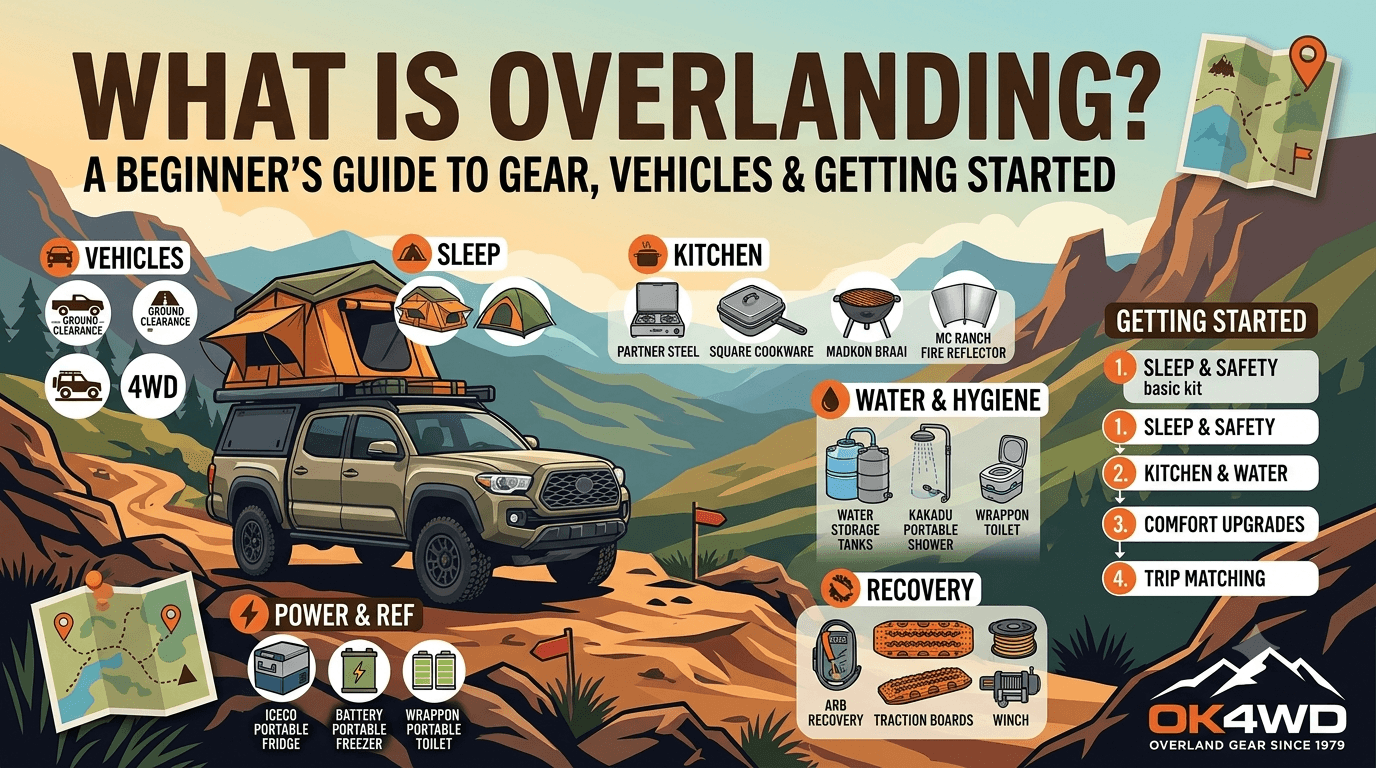
The honest answer: no — but the vehicle matters more than most beginners expect. Overlanding puts real demands on a vehicle — rough roads, loaded weight, variable terrain, and long distances between fuel and service. A few characteristics define a capable overland platform:
Ground clearance. The higher the better for unpaved roads, rocky sections, and water crossings. A lifted truck or Jeep has a meaningful advantage over a stock crossover.
Four-wheel drive. Not every overland route requires 4WD, but the routes worth doing usually do. A true 4WD system with low-range gearing gives you options when conditions change.
Reliability and repairability. Overlanders favor platforms with deep aftermarket support and straightforward mechanicals — vehicles you can work on in the field if needed. Toyota Tacomas, Jeep Wranglers, Ford Broncos, and full-size trucks dominate the overland world for exactly this reason.
Payload capacity. Overlanding gear adds up fast. Rooftop tent, water, fuel, recovery gear, food, kitchen — a fully loaded build can add 500–800 lbs to a vehicle. Know your payload rating before you start stacking gear.
You don't need to start with a fully built rig. Many overlanders begin with a stock truck and add gear gradually as their experience and priorities develop. The vehicle you have is usually good enough to get started.
The Core Categories of Overlanding Gear
Sleep
Where you sleep defines a lot of your setup. There are three main options:
Rooftop tent (RTT) — Mounts to your roof rack and deploys in minutes. Keeps you off the ground, away from critters, and elevated above morning moisture. The most popular overlanding sleep solution for good reason — fast setup, comfortable, and self-contained.
Ground tent — More flexible, lighter, and less expensive than an RTT. Works well if you're newer to overlanding and not ready to commit to a roof rack and tent system.
Sleeping in the vehicle — For trucks with bed platforms or larger SUVs, sleeping inside the vehicle is a clean, protected option. Popular for solo overlanders and van builds.
Kitchen and Cooking
Camp cooking is one of the most underrated parts of overlanding — a good meal at the end of a long trail day matters more than most people expect before their first trip.
Partner Steel — Partner Steel makes aluminum camp stoves built for serious use. Their two-burner and single-burner systems are compact, durable, and designed to handle the kind of daily use that overlanding demands. Aluminum construction keeps weight manageable without sacrificing durability.
Square Cookware — Square Cookware's stackable camp cookware system is designed specifically for vehicle-based travel where space and organization matter. Pots, pans, and lids nest together in a compact stack that packs efficiently and unpacks into a fully functional camp kitchen. For overlanders who want to cook real food without carrying a chaotic pile of mismatched gear, Square Cookware is the right solution.
Madkon Braai — A Braai is a South African-style open fire grill — and Madkon's portable version brings that tradition to the overland camp. If campfire cooking is part of your vision for overlanding, a Madkon Braai is a distinctive and capable alternative to a standard camp grill. It travels well, sets up quickly, and produces the kind of meals that make a base camp feel like a destination.
MC Ranch Overland Fire Reflectors — MC Ranch Overland's fire reflectors are a thoughtful addition to any camp kitchen or fire setup. By directing heat outward from the fire toward the camp, they extend the warmth and usability of your fire — particularly valuable on cooler nights at elevation or in the shoulder seasons when overlanding is at its best.
Water and Hygiene
Water management is one of the most important and most underplanned aspects of overlanding for beginners. You need water for drinking, cooking, and basic hygiene — and you need more of it than you think.
Start with a quality water storage system — hard-sided tanks mounted to the vehicle or quality jerry cans are the standard. Plan for at least one gallon per person per day for drinking and cooking, more if you're in a hot climate or doing strenuous activity.
Kakadu Portable Showers — Kakadu makes portable shower units designed for vehicle-based travel. A pressurized portable shower changes the overlanding experience significantly — even a quick rinse after a muddy trail day or a proper wash-up before cooking makes multi-day trips dramatically more comfortable. Kakadu's units are compact, easy to use, and a practical addition to any overland kit.
Wrappon Portable Toilet — Wrappon is a self-sealing portable toilet system designed for use anywhere — no cassette, no chemicals, no odor. Each use wraps and seals automatically, making disposal clean and straightforward. For overlanding trips where restroom facilities don't exist and Leave No Trace principles matter, Wrappon is the most practical solution we've seen. It travels compactly and removes one of the less glamorous but genuinely important logistics of multi-day remote travel.
Power and Refrigeration
ICECO Portable Fridge/Freezers — ICECO makes portable fridge and freezer units purpose-built for vehicle-based travel. Running off your vehicle's 12V system or an auxiliary battery, an ICECO fridge keeps food and drinks cold for the duration of your trip without ice — no cooler drainage, no soggy food, no daily ice run. For multi-day trips, a quality portable fridge is one of the most impactful comfort upgrades you can make. ICECO's lineup covers a range of sizes and configurations to match your vehicle and trip length.
Recovery Gear
Self-reliance is a core overlanding value — and recovery gear is what makes it real. Getting stuck is not a matter of if but when, and being equipped to get yourself out without outside help is the difference between a story you tell at the campfire and a situation that requires a rescue.
At minimum every overland rig should carry a quality recovery strap, a set of shackles, a hi-lift jack, traction boards, and a shovel. For more remote trips, a winch is worth serious consideration. ARB's recovery gear lineup is among the most trusted in the industry and covers everything from basic straps to complete recovery kit packages.
Building Your Kit — Where to Start
Beginners often make one of two mistakes: they either try to buy everything at once and overwhelm themselves, or they under-prepare and find out what they're missing on the trail. Here's a practical starting sequence:
Start with sleep and safety. A way to sleep comfortably and basic recovery gear are the two non-negotiables. Everything else can be added over time.
Add kitchen and water next. Eating well and staying hydrated make multi-day trips sustainable. A Partner Steel stove, Square Cookware, and a basic water storage system get you there.
Layer in comfort. Once the basics are covered, hygiene and comfort upgrades — Kakadu shower, Wrappon toilet, ICECO fridge — transform the experience from survival mode to something genuinely enjoyable.
Match your gear to your trips. A weekend trip two hours from home has different requirements than a two-week expedition in the backcountry. Buy for the trips you're actually planning, not the most extreme scenario you can imagine.
Bottom Line
Overlanding is one of the most rewarding ways to experience the outdoors — self-reliant, unhurried, and capable of taking you places that most people never see. The gear list can look overwhelming from the outside, but it builds naturally over time as your trips get longer and your priorities clarify. Start with the basics, get out on the trail, and let experience guide the rest.
At OK4WD we carry a full range of overland gear — from ARB recovery equipment and ICECO fridges to Partner Steel stoves, Square Cookware, Kakadu showers, Madkon Braais, MC Ranch Overland fire reflectors, and Wrappon portable toilets. Stop into our Stewartsville location or give us a call — we love helping new overlanders put together their first kit.
OK4WD has been equipping Jeeps and trucks for adventure since 1979. Browse our overland gear inventory or talk to our team about building your first kit.
FAQs
How much does it cost to get started with overlanding?
It varies widely depending on your vehicle and how you build your kit. A functional beginner setup — rooftop tent or ground tent, basic kitchen, recovery gear, and water storage — can come together for $2,000–$5,000. A fully built rig with a lifted vehicle, ARB accessories, rooftop tent, and complete camp kitchen can run $20,000–$50,000+. Most overlanders build gradually over years rather than all at once.
Do I need a lifted vehicle to overland?
No — but ground clearance matters on more technical routes. Many overlanders start on maintained forest roads and fire roads that a stock truck handles without issue. Lift your vehicle when your routes demand it, not before.
Is overlanding safe?
Overlanding involves real risks — remote terrain, variable weather, mechanical failures, and navigation challenges. The mitigation is preparation: recovery gear, communication equipment, trip planning, and telling someone where you're going. The community is also genuinely welcoming and most experienced overlanders will stop to help someone in need on the trail.
Where do overlanders go?
National forests, BLM land, state forests, and designated backcountry routes are the most common destinations. Apps like iOverlander, Gaia GPS, and OnX Offroad are essential planning tools for finding routes and campsites.