How to Wash and Maintain Your Undercarriage After Muddy Trails
The trail gets all the glory. The undercarriage takes all the abuse. Mud, sand, water, rocks, and road salt work their way into every crevice of your vehicle's underside — and if you're not actively managing it, the damage accumulates quietly until it becomes expensive. This guide covers how to properly clean and protect your undercarriage after off-road use, and why making it part of your post-trail routine is one of the best investments you can make in your rig's long-term health.
Why Undercarriage Care Matters More Than Most People Think
A clean exterior is obvious. Undercarriage neglect is invisible — right up until a brake line corrodes through, a suspension component seizes, or a frame rail rusts to the point of structural compromise. In the NJ/PA region where road salt is used aggressively through winter, undercarriage maintenance isn't optional for any vehicle — it's especially critical for trucks and Jeeps that spend time off-road and accumulate mud and moisture in every corner of the underside.
Mud is particularly insidious because it traps moisture against metal surfaces long after you've left the trail. A vehicle that looks clean after a basic rinse may still have packed mud behind skid plates, inside frame rails, around control arm mounts, and in wheel well liners — sitting wet against bare metal for days at a time.
Step 1 — Rinse While It's Fresh
The single most effective thing you can do is rinse your undercarriage as soon as possible after a trail run — before the mud dries and hardens. Dried mud is significantly more difficult to remove and the longer it sits against metal, the more moisture it holds in place.
A standard garden hose with a spray nozzle will handle light mud and dust. For heavier trail mud — the kind that packs into recesses and around components — a pressure washer is the right tool. Keep the nozzle moving and maintain a reasonable distance from rubber seals, wiring harnesses, and sensors. Concentrated pressure on seals and electrical connections can cause more problems than the mud itself.
What to focus on:
- Frame rails and crossmembers
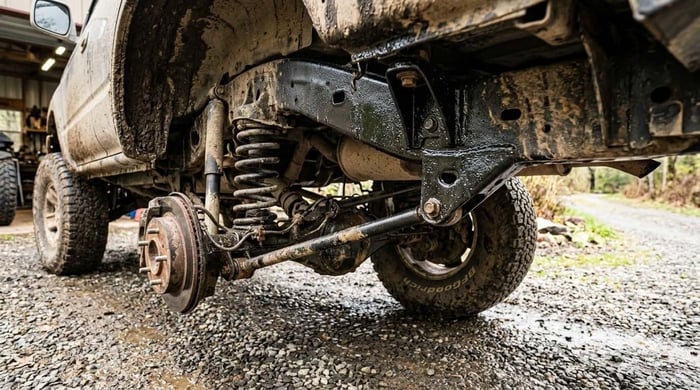
- Control arms, track bars, and suspension links
- Behind and around skid plates
- Wheel wells and inner fenders
- Differential housings and axle tubes
- Brake lines and fuel lines
- Around the transfer case and transmission
Don't neglect the wheel wells — mud packs densely behind inner fender liners and holds moisture directly against the fender structure. Pull back any flexible liners and rinse thoroughly.
Step 2 — Full Wash with Soap
After the initial rinse, a full undercarriage wash with automotive soap removes the residue that water alone won't touch — trail dust, fine silt, oil film, and road grime. A long-handled brush helps reach recessed areas around suspension components and frame rails that a pressure washer alone can't clean thoroughly.
For vehicles that have been in salt water or salt-heavy mud — coastal trails, winter wheeling, or post-snowstorm runs — a dedicated salt-neutralizing rinse is worth adding to the routine. Salt accelerates corrosion significantly and a standard soap rinse doesn't fully neutralize it.
Rinse thoroughly after soaping. Soap residue left on metal surfaces can actually attract moisture — defeating the purpose of the wash.
Step 3 — Dry Thoroughly
Standing water in frame rails, around suspension mounts, and inside wheel wells continues the corrosion process after the wash. After rinsing, a short drive helps clear water from recesses through vibration and airflow. Compressed air directed into cavities and around components speeds the process significantly if you have access to it at your shop or garage.
On warmer days, parking in the sun with the vehicle elevated — on ramps or a lift — allows airflow underneath and accelerates drying. In cooler months this matters more, not less — water sitting in frame cavities overnight in near-freezing temperatures expands and stresses seams and welds.
Step 4 — Inspect While You're Under There
A post-wash undercarriage inspection is one of the most practical maintenance habits an off-road driver can develop. With the vehicle clean and well-lit, you can see things that are invisible under trail grime:
- Brake line condition and routing
- Fuel line integrity
- Suspension component wear — torn boots, cracked bushings, loose hardware
- Skid plate mounting hardware — loose bolts are common after rocky trail use
- Frame rail condition — surface rust, cracks, or deformation
- Differential and transfer case for leaks
Catching a torn CV boot, a loose skid plate bolt, or an early rust spot after a trail run costs almost nothing to address. Finding the same issues after months of neglect is a different conversation entirely.
Step 5 — Protect with Undercoating
Cleaning the undercarriage matters. Protecting it afterward is what makes the cleaning last.
Fluid Film — Fluid Film is a lanolin-based corrosion inhibitor and lubricant that our shop recommends as a front-line undercarriage protection product. It penetrates into seams, crevices, and overlapping metal surfaces where moisture collects — exactly the areas most vulnerable to corrosion. Unlike hard-shell undercoatings that can crack and trap moisture underneath, Fluid Film remains flexible and self-healing, continuing to protect even in areas subject to flex and vibration. It's particularly effective in the NJ/PA environment where road salt exposure is significant — apply it to frame rails, suspension components, brake and fuel lines, and any bare metal surface on the underside. Reapplication once or twice a season is recommended for vehicles that see regular trail or winter use.
Zinc-Based Undercoating — For areas where a more durable barrier is appropriate — particularly bare metal on frame rails, floor pans, and structural components — a zinc-based undercoating provides a harder protective layer with excellent corrosion resistance. Zinc's galvanic protection properties make it particularly effective against rust formation on steel surfaces. Our shop recommends zinc-based products for areas that have been cleaned down to bare metal or that have had previous undercoating removed — it provides the foundation layer over which a product like Fluid Film can be applied for ongoing maintenance protection.
Used together, Fluid Film and zinc-based undercoating provide a layered defense — zinc for structural protection on exposed metal, Fluid Film for ongoing penetrating corrosion inhibition across the full undercarriage. It's the combination our shop applies to customer vehicles and recommends for any rig that sees serious off-road or winter use.
How Often Should You Do This?
| Use Case | Recommended Frequency |
|---|---|
| After every muddy trail run | Rinse and inspect — always |
| Monthly during trail season | Full wash and inspection |
| Before and after winter | Full wash, inspect, and reapply Fluid Film |
| After salt water or heavy salt exposure | Full wash with salt neutralizer within 24 hours |
| Annual | Full undercoating inspection and touch-up |
A Note on DIY vs. Professional Undercoating
A post-trail rinse and basic wash is straightforward DIY territory. Full undercoating application — particularly zinc-based products on bare metal — benefits from professional application for thorough coverage of recessed areas, proper surface preparation, and correct product selection for your vehicle's specific needs.
If your undercarriage is overdue for attention or you've just picked up a used rig with unknown undercarriage history, a professional inspection and treatment is a worthwhile investment before the next trail season.
Bottom Line
Your undercarriage works harder than any other part of your vehicle and gets the least attention. A consistent post-trail routine — rinse, wash, dry, inspect, and protect — is straightforward, inexpensive relative to repair costs, and makes a measurable difference in how long your rig stays solid. Fluid Film and zinc-based undercoating are the protection products our shop trusts and recommends for the NJ/PA environment and serious off-road use.
Stop into our Stewartsville location to talk undercarriage protection or schedule a professional application with our service team.
OK4WD has been building and protecting Jeeps and trucks since 1979. Talk to our service team about undercarriage protection for your rig.
FAQs
Can I use a pressure washer on my entire undercarriage?
Yes, with care. Keep the nozzle moving, maintain reasonable distance from rubber seals, wiring, and sensors, and avoid directing concentrated pressure into wheel bearings or axle seals. A pressure washer is one of the most effective undercarriage cleaning tools when used correctly.
How long does Fluid Film last?
Fluid Film typically lasts 6–12 months depending on exposure conditions. Vehicles that see heavy winter road salt or frequent trail use benefit from reapplication every season. It's a maintenance product — not a one-time treatment.
Is undercoating worth it on an older vehicle?
Yes — particularly if the undercarriage is still in good condition. Undercoating an already-rusted frame has limited value, but a vehicle with solid structure and surface rust is an excellent candidate for treatment. Stopping corrosion progression at that stage extends vehicle life significantly.
Should I undercoat a new vehicle?
Factory undercoating on most new vehicles is minimal. Having a professional undercoating applied within the first year — before the first winter — is one of the best long-term investments you can make on a vehicle you plan to keep and use off-road.