Roof Racks for Overland Builds — What to Know Before You Buy
A roof rack is one of the most transformative upgrades you can make to an overland rig. Done right, it turns your vehicle's unused roof space into a functional platform for gear, lighting, recovery equipment, and shelter — and gives your build the purpose-built look that matches how you're using the truck. Done wrong, it's an expensive, noisy, fuel-hungry mistake that doesn't fit your actual needs. This guide covers what to look for, how to match a rack to your build, and which brands we trust at OK4WD.
Why a Roof Rack Is More Than a Gear Carrier
Most people think of a roof rack as a place to strap stuff. That's part of it — but a quality overland rack does more than add cargo space. It's a mounting platform for rooftop tents, a base for light bars and auxiliary lighting, an anchor point for awnings, a home for water and fuel jerry cans, and in many builds the structural backbone that ties the entire exterior kit together.
Choosing the right rack means thinking about how all of those functions work together — not just how much gear you can pile on top.
Key Considerations Before You Buy
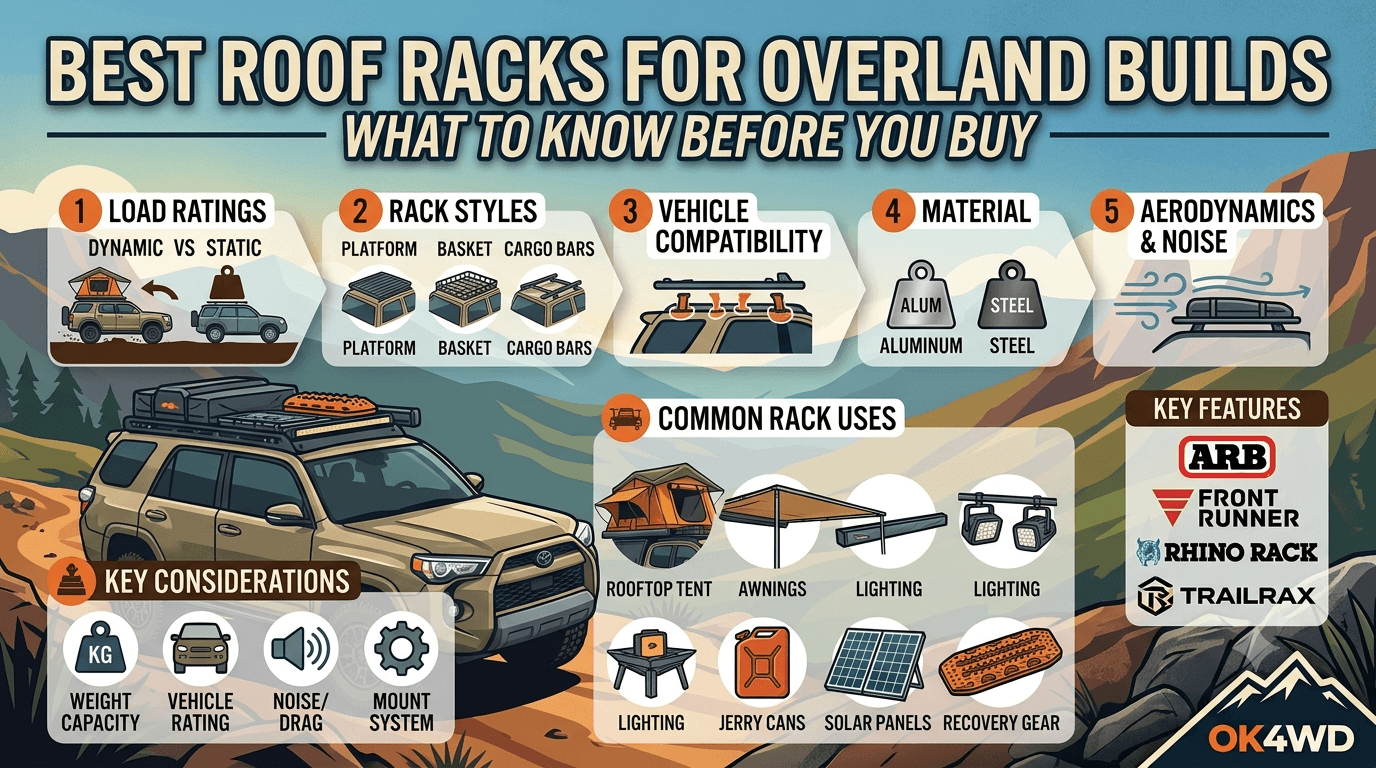
Weight capacity and payload. Every rack has a dynamic load rating — how much weight it can carry while the vehicle is moving — and a static load rating for when the vehicle is parked. Dynamic ratings matter most for day-to-day use. A rooftop tent alone can weigh 100–150 lbs before you factor in bedding and occupants. Add a spare tire, water, and lighting and you're pushing the limits of lesser racks quickly. Know your numbers before you buy.
Your vehicle's roof load rating. The rack's capacity is only half the equation — your vehicle's roof has its own load rating from the factory. Exceeding it puts stress on the roof structure and can affect handling. Check your owner's manual and confirm with your installer.
Rack style — platform vs. basket vs. cargo bars. Platform racks offer a flat, solid mounting surface ideal for rooftop tents and integrated accessories. Basket racks provide structure around the perimeter for containing loose gear. Cargo bar systems are lighter and more aerodynamic but offer less mounting flexibility. Most serious overland builds use a full platform rack.
Aerodynamics and wind noise. A roof rack adds drag — how much depends on design, height, and whether it's loaded. Quality racks are engineered to minimize wind noise and fuel economy impact. Cheap racks turn your highway drive into a wind tunnel experience. If your build includes significant highway miles, aerodynamic design matters.
Mounting system. Racks mount to your vehicle through the factory roof rails, rain gutters, or directly to the roof via vehicle-specific mounting points. Factory rail mounts are the most common and cleanest solution on modern trucks and SUVs. Confirm compatibility with your specific vehicle before purchasing — fitment varies significantly by make, model, and year.
Material — steel vs. aluminum. Steel racks are heavier but extremely strong — a good choice for builds that will see serious abuse. Aluminum racks save significant weight while maintaining structural integrity for most overland applications. Given that roof weight affects your vehicle's center of gravity, the weight savings of aluminum matter more on a roof rack than almost anywhere else on the build.
The Brands We Carry
ARB — ARB's roof rack systems are engineered for the demands of serious overlanding — robust construction, high load ratings, and integration with ARB's broader ecosystem of awnings, lighting, and accessories. Their steel platform racks are built to take abuse and mount securely to a wide range of vehicle platforms. For builds where durability and load capacity are the priority, ARB is the conversation to start with. The integration with ARB awnings and recovery gear makes them particularly compelling for overlanders building a complete ARB system.
Front Runner — Front Runner has become one of the most recognized names in overland roof rack systems and their reputation is earned. Their Slimline II platform rack is one of the most popular overland racks on the market — lightweight, modular, and designed around a comprehensive accessory ecosystem that includes mounts for nearly every piece of gear you might want to carry. Front Runner's modular approach means you configure the rack around your specific needs rather than working around a fixed design. Strong fitment coverage across Jeeps, trucks, and SUVs makes them one of the most versatile options available.
Rhino Rack — Australian-made and proven in some of the harshest overlanding environments on earth, Rhino Rack produces a broad range of roof rack systems from cargo bars to full platform racks. Their Pioneer platform series is a strong overland option — solid construction, good load ratings, and a growing accessory ecosystem. Rhino Rack's broad vehicle compatibility makes them a go-to for platforms where other brands have limited fitment options. For overlanders who want proven Australian engineering at an accessible price point, Rhino Rack delivers.
Trailrax — Trailrax is an American-made modular rack system built around two core principles: strength and adaptability. Their racks feature integrated bends engineered specifically to enhance structural strength — a design detail that separates them from racks that rely on flat sheet metal construction. The modular architecture means your rack grows with your build — add mounting points, accessory rails, and storage solutions as your kit evolves rather than replacing the whole system. For overlanders who want American-made quality with the flexibility to customize their setup over time, Trailrax is a brand worth knowing. They cover both roof and truck bed applications, making them a versatile option across different vehicle configurations and build goals.
Roof Rack vs. Truck Bed Rack — Which Do You Need?
This is a question that comes up often with truck owners, and the answer depends on how you use your vehicle.
Roof racks maximize cargo space without sacrificing bed access. They're the right choice for mounting rooftop tents, lighting, and gear that benefits from height — antennas, solar panels, and anything you want accessible from outside the vehicle without digging through the bed.
Truck bed racks keep weight lower on the vehicle — better for center of gravity — and are ideal for building a sleep platform, organizing bed cargo, or mounting gear that you access frequently. Trailrax covers both applications, which makes them particularly flexible for truck owners deciding between the two.
Many serious overland truck builds run both — a bed rack for the primary sleep and storage setup and a cab-over or full roof rack for lighting and additional gear mounting. It's not either/or if your build demands both.
What Can You Mount on a Roof Rack?
The short answer: a lot. Here's what most overland builds use roof racks for:
Rooftop tents — the most popular roof rack application. Confirm your rack's dynamic load rating supports the tent weight before purchasing.
Awnings — ARB, Front Runner, and Rhino Rack all offer awning systems that mount directly to their racks. A side or rear awning dramatically expands your usable camp space.
Lighting — light bars, spot lights, and driving lights mount cleanly to roof rack cross bars and rails. Height gives you maximum throw distance on the trail.
Jerry cans — water and fuel storage mounted to the rack keeps your bed and interior clear. Confirm your rack has the correct mounting points or accessory rails for jerry can holders.
Solar panels — for builds with auxiliary battery systems, roof-mounted solar panels are a clean, out-of-the-way power solution.
Recovery gear — Hi-lift jacks, traction boards, and shovels mount to rack rails and stay accessible without cluttering the interior.
How Much Do Roof Racks Cost?
| Rack Type | Approximate Cost |
|---|---|
| Cargo bar system (entry level) | $200–$500 |
| Basket rack (mid-range) | $400–$900 |
| Platform rack (overland-spec) | $800–$2,000+ |
| Full platform with accessories | $1,500–$3,500+ |
Installation typically runs 2–4 hours depending on vehicle and rack complexity. Vehicle-specific mounting hardware is often sold separately — confirm what's included before purchasing.
Bottom Line
A roof rack is one of the highest-impact upgrades on an overland build — it unlocks sleeping, shade, lighting, and cargo solutions that simply aren't possible without one. Start with the right rack for your vehicle and your build goals, confirm load ratings against your actual gear list, and choose a brand engineered for the demands of real overlanding use.
At OK4WD we carry ARB, Front Runner, Rhino Rack, and Trailrax across a broad range of vehicles. Whether you're building a dedicated overland rig or adding your first rack to a daily driver, we'll help you find the right fit. Stop into our Stewartsville location or give us a call.
OK4WD has been equipping Jeeps and trucks for adventure since 1979. Browse our roof rack inventory or talk to our team about the right setup for your build.
FAQs
Will a roof rack affect my fuel economy?
Yes — any roof rack adds aerodynamic drag. The impact varies by rack design, load, and highway speed. Quality racks minimize this through aerodynamic profiling, but expect a modest reduction in fuel economy, particularly at highway speeds with a loaded rack.
Can I install a roof rack myself?
Many rack systems are DIY-friendly with the right tools and a careful read of the instructions. Vehicle-specific mounting systems simplify the process. That said, a professional install ensures correct torque specs, proper fitment, and load rating confidence — particularly important if you're mounting a rooftop tent.
How do I know if a rack fits my vehicle?
Confirm fitment with your installer or the rack manufacturer using your exact year, make, model, and trim. Roof rail configuration and roof geometry vary significantly — a rack that fits a JL Wrangler won't necessarily fit a JK.
Can I use a roof rack on a leased vehicle?
Possibly — but confirm with your lease agreement first. Most rail-mounted systems don't damage the vehicle and are fully reversible, but check before drilling or permanently modifying anything.