CB Radio vs. Ham Radio vs. GMRS — Which Communication Setup Is Right for You?
Communication is one of the most overlooked pieces of an off-road or overland kit — right up until the moment you need it. Whether you're running a group trail day, deep in a national forest without cell service, or setting up a base camp miles from the nearest town, having the right radio setup can make the difference between a minor inconvenience and a serious emergency. This guide breaks down the three main options, what each is good for, and how to choose the right setup for how you actually use your rig.
Why Cell Phones Aren't Enough
Before diving into radio types, it's worth addressing the obvious: most people's first instinct in an emergency is to reach for their phone. That works fine on the highway or in town. It works considerably less well when you're 30 miles into a trail system in the Pine Barrens, crossing a river in the Appalachians, or camped in a canyon in the Southwest where cell coverage simply doesn't exist.
Radios don't rely on cell towers, don't depend on data plans, and don't run out of signal when you're in a dead zone. They work when nothing else does — which is exactly when you need them most.
The Three Main Options
CB Radio — Citizens Band
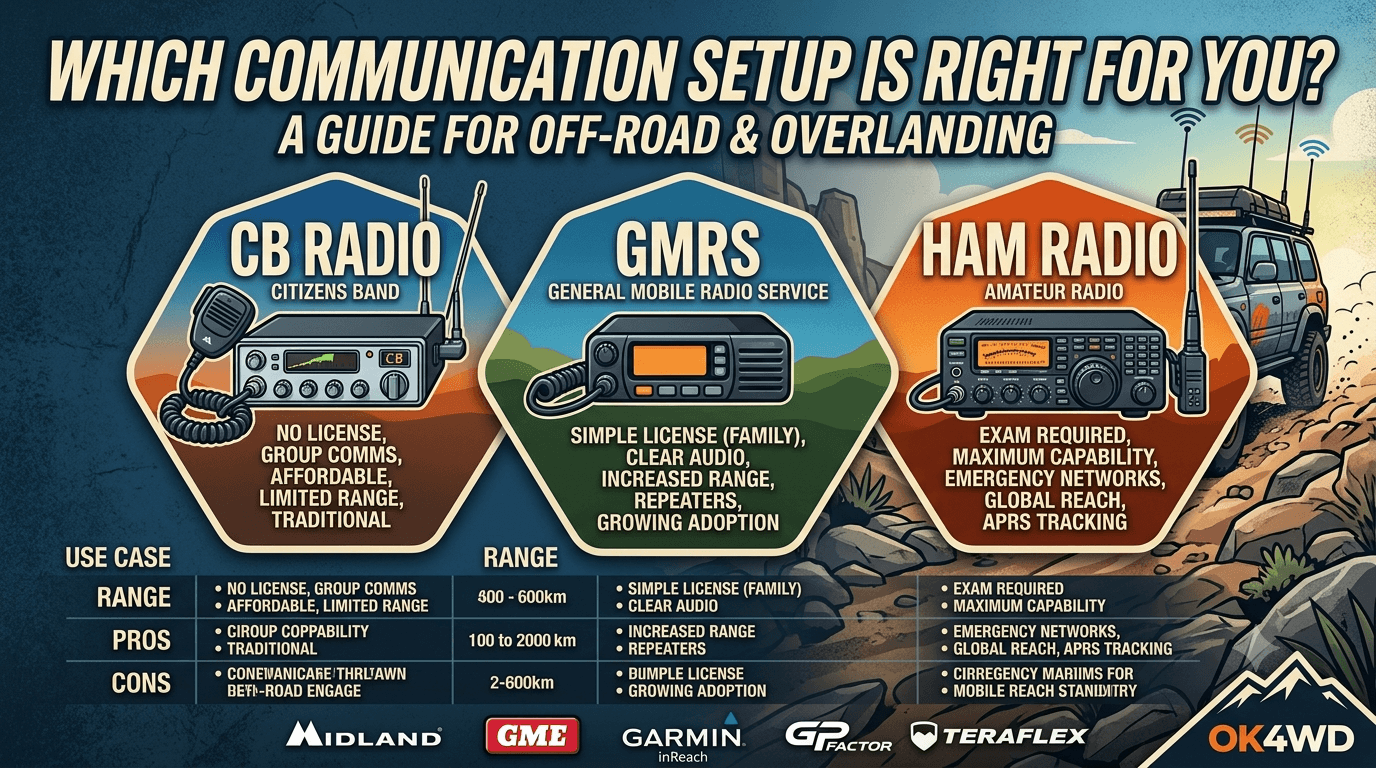
CB radio has been the standard trail communication tool for decades and remains the most widely used option in the off-road community. No license is required, radios are inexpensive, and the install is straightforward. CB operates on 40 channels in the 27 MHz frequency band — Channel 19 is the traditional truckers' channel, and Channel 4 is commonly used by off-road groups on the trail.
Range: Typically 1–5 miles in open terrain, less in canyons, dense forest, or hilly terrain. CB range is affected significantly by terrain and antenna quality.
Pros: No license required, universally understood in the off-road community, affordable entry point, wide trail adoption means other wheelers you encounter are likely on CB.
Cons: Limited range, prone to interference, audio quality can be poor, no privacy on shared channels.
Best for: Group trail runs, convoy communication, day trips where the group stays relatively close together. CB is the baseline — if you wheel with others, you need one.
GMRS — General Mobile Radio Service
GMRS has grown significantly in popularity in the off-road and overlanding community over the past several years and for good reason. It operates in the UHF band (462–467 MHz), offers significantly better audio clarity than CB, and provides meaningfully improved range — particularly in hilly or forested terrain where CB struggles.
A GMRS license is required from the FCC, but it's a simple application process — no exam required — and the license covers your entire immediate family for ten years at a modest fee. Most of the off-road community considers this a minor barrier relative to the performance improvement over CB.
GMRS also supports repeaters — fixed radio relay stations that can dramatically extend range in areas where they've been installed. In regions with active GMRS repeater networks, range extends far beyond what CB or handheld GMRS radios can achieve on their own.
Range: 5–25+ miles depending on terrain, antenna, and whether repeaters are available.
Pros: Better range and audio clarity than CB, family license covers multiple users, repeater capability, growing adoption in the overland community.
Cons: Requires FCC license, less universally adopted than CB on the trail, shared channels mean no guaranteed privacy.
Best for: Overland trips, multi-day expeditions, base camp communication, group runs where range matters, and anyone who wants a step up from CB without the complexity of ham radio.
Ham Radio — Amateur Radio
Ham radio is the most capable and most complex of the three options. It operates across a wide range of frequency bands, offers the longest range of any option covered here, and with the right setup can reach literally anywhere on the planet. In a true emergency situation — lost, injured, or stranded far from help — ham radio is the most powerful communication tool available to a civilian.
The barrier to entry is higher than CB or GMRS: a Technician class license is required at minimum, which involves passing a 35-question exam covering basic radio theory, regulations, and operating practices. The exam isn't difficult with modest preparation — most people pass with a few weeks of study — but it is a real commitment compared to the no-exam CB or simple-license GMRS options.
Ham radio also unlocks access to the APRS (Automatic Packet Reporting System) network, which allows GPS position tracking and digital messaging — a meaningful safety tool on remote expeditions.
Range: Virtually unlimited with the right equipment and conditions.
Pros: Maximum range and capability, APRS tracking, emergency communication network access, respected and supported by search and rescue organizations.
Cons: Requires FCC license with exam, more complex equipment and operation, higher cost, steeper learning curve.
Best for: Remote expeditions, international travel, serious overlanders who regularly travel far from cell coverage, and anyone who wants the highest level of communication capability and emergency preparedness.
Base Camp and Emergency Considerations
The communication conversation changes when you're talking about base camp setups and emergency preparedness rather than just trail communication.
Base camp benefits from a more powerful fixed radio setup — a vehicle-mounted or standalone GMRS or ham radio with an external antenna provides significantly better range and reliability than a handheld unit. If your camp is the coordination point for a group running different trails, a capable base station keeps everyone connected.
Emergency communication is where ham radio earns its reputation. Search and rescue organizations operate on ham frequencies, APRS tracking gives rescuers your GPS position, and the range capability means you can reach help even when you're genuinely remote. For serious expeditions into truly remote terrain, a Technician class ham license and a capable radio is the most responsible communication setup available.
Satellite communicators are worth mentioning here as a complement to radio — not a replacement. Devices like the Garmin inReach allow two-way text messaging and SOS capability via satellite anywhere on earth, with no radio license required. For emergency preparedness, pairing a satellite communicator with a trail radio gives you redundancy that no single system can match.
The Brands We Carry
GME — Australian-made and built for demanding environments, GME produces a range of UHF CB and GMRS radios that are well-regarded for build quality and audio clarity. Their products are a strong choice for overlanders who want reliable hardware that holds up in harsh conditions.
Midland — One of the most recognized names in GMRS radio, Midland's MXT and MXT400 series mobile GMRS radios have become a go-to for the overland community. Easy to install, intuitive to operate, and offering strong range and audio quality, Midland is a natural first step for anyone moving from CB to GMRS. Their handheld T-series radios are also a practical addition for on-foot communication at base camp.
Garmin — As a Garmin dealer, we carry their inReach satellite communicator lineup — the inReach Mini and inReach Messenger are the standout products for off-road and overland use. Two-way satellite messaging, SOS capability with 24/7 monitoring, and GPS tracking make the inReach the most important safety tool you can add to a remote expedition kit. It works everywhere, requires no radio license, and pairs naturally with any radio setup as your emergency backup.
GP Factor — GP Factor produces quality antenna mounts and radio accessories purpose-built for off-road use. Their mount solutions are designed to handle trail vibration and abuse while keeping your antenna positioned correctly for optimal performance — details that matter more than people realize until they've dealt with a loose mount mid-trail.
TeraFlex — TeraFlex's antenna mounts and CB/radio mounting solutions are engineered specifically for Jeep platforms — clean integration, correct positioning, and hardware that holds up. For Wrangler and Gladiator owners looking for a factory-quality radio install, TeraFlex mounts are the right solution.
Which Setup Is Right for You?
| Use Case | Recommended Setup |
|---|---|
| Casual trail days with a group | CB radio — affordable, universal, no license |
| Regular trail runs, convoy communication | GMRS — better range and clarity, easy license |
| Multi-day overland trips | GMRS + Garmin inReach for emergency backup |
| Remote expeditions, serious backcountry | Ham radio + Garmin inReach |
| Base camp coordination | Vehicle-mounted GMRS or ham with external antenna |
The honest answer for most off-road drivers: start with GMRS. It's a meaningful step up from CB, the license is painless, and the Midland MXT series makes installation straightforward. Add a Garmin inReach and you have trail communication and emergency capability covered in two products.
Bottom Line
There's no single right answer for every driver — the best communication setup depends on how you use your rig, where you go, and how serious your off-road use is. CB gets you on the air immediately with no barriers. GMRS is the upgrade most drivers should make. Ham radio is the tool for serious backcountry use. And a Garmin inReach belongs in every overland kit regardless of which radio you run.
At OK4WD we carry GME, Midland, and Garmin communications gear alongside GP Factor and TeraFlex mounting solutions. Stop into our Stewartsville location or give us a call — we'll help you put together the right communication setup for how and where you ride.
OK4WD has been equipping Jeeps and trucks since 1979. Browse our communications inventory or talk to our team about the right setup for your build.
FAQs
Do I need a license for CB radio?
No. CB radio requires no license and no exam — it's the most accessible entry point for trail communication.
How do I get a GMRS license?
Apply directly through the FCC's online licensing system (wireless.fcc.gov). No exam is required — it's a straightforward application and fee process. The license covers your entire immediate family for ten years.
Can I use GMRS and CB radios together on the same trail run?
Yes — many experienced wheelers run both. CB covers communication with other trail users who may not be on GMRS, while GMRS handles primary group communication with better clarity and range.
Is a Garmin inReach a replacement for a radio?
No — it's a complement. The inReach is a satellite communicator designed for two-way text messaging and SOS, not real-time voice communication. Pair it with a radio for complete coverage.