Recovery Gear Every Off-Roader Should Carry (and How to Use It)
Getting stuck is part of off-roading. It's not a failure — it's an inevitability. The difference between a good story and a bad day is what you're carrying when it happens. This guide covers the recovery gear every off-road driver should have on board, how each piece works, and which brands we trust at OK4WD for each category.
The Recovery Mindset
Before diving into recovery gear, it's worth establishing the right mindset around recovery. Self-recovery — getting yourself unstuck without outside help — is a core skill and a core value in the off-road community. It requires the right equipment, the knowledge to use it, and the judgment to know when a situation is beyond what you can safely handle alone.
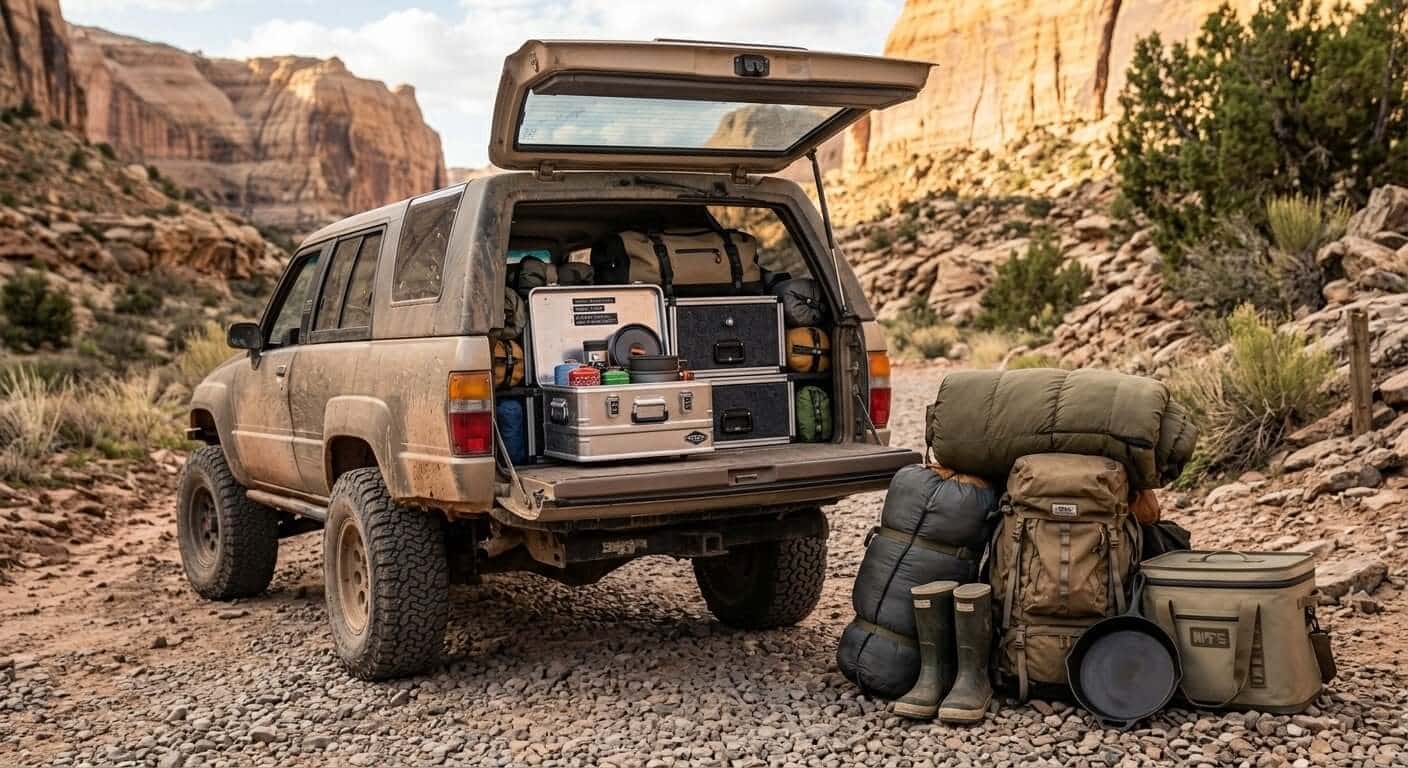
No single piece of recovery gear solves every situation. A complete recovery kit addresses multiple failure scenarios — being mired in mud, high-centered on a rock, stuck in sand, or dealing with a flat in a location where a standard spare won't cut it. Build your kit to cover a range of scenarios, not just the one you're most likely to encounter.
Winches
A winch is the most capable self-recovery tool available for a solo driver. Mounted to your front bumper and anchored to a tree, recovery point, or ground anchor, a winch pulls your vehicle out of situations that no other single piece of equipment can address.
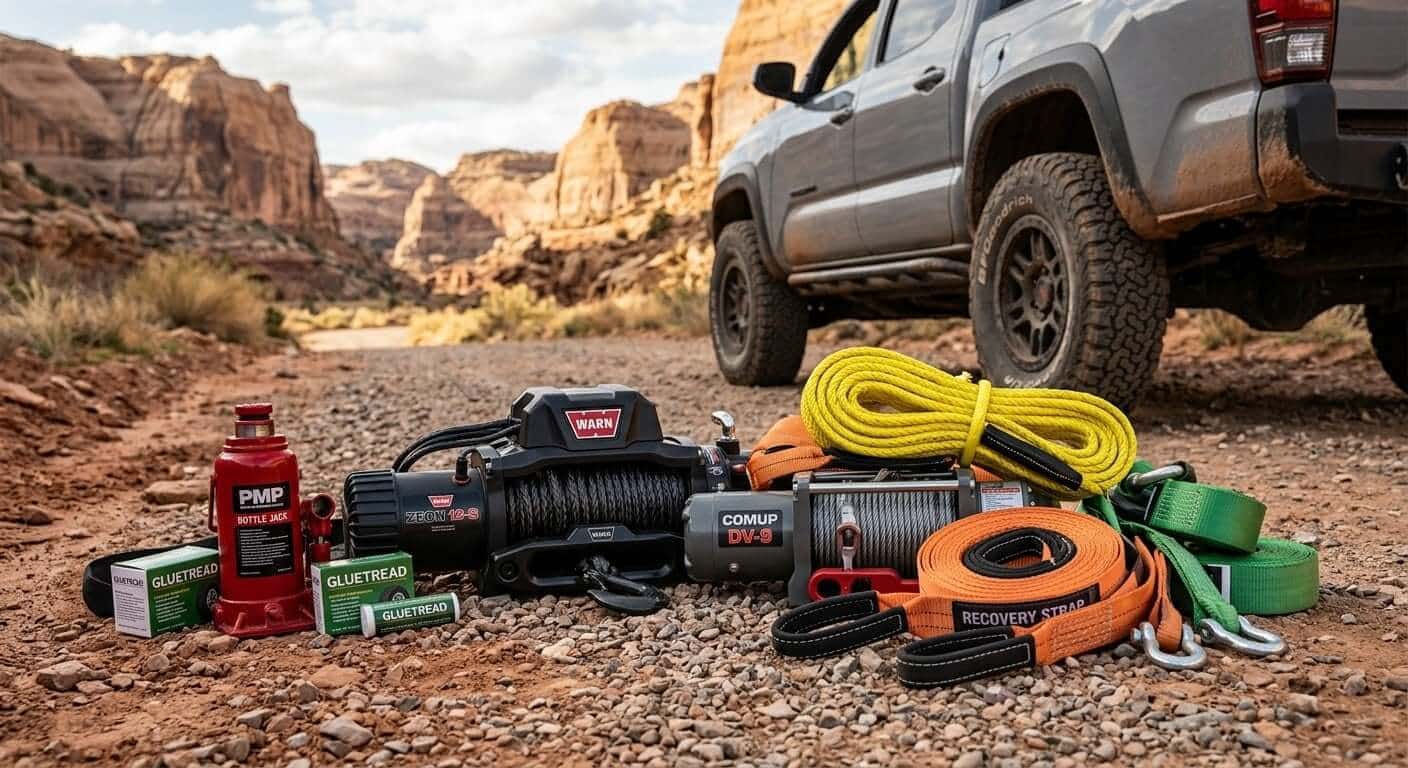
Warn — Warn is the most recognized name in off-road winches and one of the most trusted. Their Zeon and VR series winches cover a range of line pull ratings and are built for the demands of serious off-road use. Warn's reputation is built on decades of reliability in demanding conditions — when you need your winch to work, it's not the time to find out you bought the wrong one.
Comeup Winch — Comeup is a strong alternative to Warn with a loyal following in the off-road community. Their winches offer competitive line pull ratings, solid construction, and reliable performance at a price point that makes a quality winch accessible without compromising on capability. For overlanders and trail drivers who want a dependable winch without the premium Warn price tag, Comeup is a brand worth serious consideration.
Winch use basics: Always use a tree saver strap when anchoring to a tree — never wrap the winch line directly around bark. Use a winch dampener on the line to absorb energy if the line breaks under load. Wear gloves when handling synthetic or steel winch line. Never stand in line with a tensioned winch cable.
Shackles and Rigging — Factor 55
A winch or recovery strap is only as strong as its connection points. Factor 55 makes precision-machined aluminum and stainless steel shackles, fairlead attachments, and rigging components engineered specifically for off-road recovery gear. Their FlatLink and ProLink winch line terminations replace traditional steel hooks with a safer, stronger connection system — no hook to snap back under load, no sharp edges to damage synthetic winch line. For anyone running a winch, upgrading to Factor 55 termination hardware is one of the most impactful safety improvements you can make to your recovery setup.
Recovery Straps
A quality kinetic recovery strap — sometimes called a snatch strap — is one of the most versatile and most used pieces of recovery gear in any kit. Unlike a static tow strap, a kinetic strap stretches under load and stores energy — when the recovering vehicle pulls forward, the strap releases that stored energy in a controlled surge that breaks the stuck vehicle free with significantly less shock load on both vehicles.
Bubba Rope — Bubba Rope is one of the most trusted names in kinetic recovery straps. Their nylon rope straps are rated for serious pull loads, hold up to repeated use, and deliver the kinetic energy transfer that makes recovery strapping effective. Bubba Rope's color-coded system makes it easy to select the right strap for your vehicle's weight class. A quality kinetic strap from Bubba Rope belongs in every recovery kit regardless of what other gear you're running.
Strap use basics: Never attach a recovery strap to a trailer hitch ball — they're not designed for the load and can become dangerous projectiles if they fail. Use rated recovery points or D-ring shackles mounted to purpose-built recovery points on the vehicle's frame.
Jacks
A jack is essential for tire changes, getting a high-centered vehicle back on its wheels, and a range of recovery scenarios where you need to lift the vehicle to place traction boards or reposition a stuck tire.
PMP Compact Hydraulic Bottle Jack — Our shop prefers the PMP compact hydraulic bottle jack over traditional hi-lift jacks for most recovery scenarios. Hydraulic bottle jacks are inherently more stable than hi-lift jacks — they don't rely on a ratcheting mechanism that can slip under load, they have a lower center of gravity, and they're significantly more compact and easier to store in a trail kit. The PMP is purpose-built for off-road use in a package that stores easily without taking up valuable kit space. For drivers who want reliable, safe jack capability in a compact form factor, the PMP is our go-to recommendation.
Hi-Lift Jack — The Hi-Lift jack has been an off-road staple for decades and remains a versatile tool — particularly for lifted vehicles where a bottle jack's range doesn't reach the frame. A Hi-Lift can jack, winch, clamp, and spread — it's a multi-function tool that earns its place in a complete recovery kit. That said, Hi-Lift jacks require more care and technique to use safely than a hydraulic bottle jack — they can slip under load if not positioned correctly and the tall lift height makes them less stable on soft ground. Use a base plate on soft surfaces and always keep your hands and body clear of the handle arc.
The honest take: for most trail drivers, the PMP hydraulic bottle jack is the safer and more practical primary jack. A Hi-Lift earns its place as a secondary tool for scenarios where additional reach or the jack's winching capability is needed.
Traction Boards
Traction boards — also called recovery boards — give your tires something to grip when you're mired in mud, sand, or snow. Slide them under the spinning tire, drive onto them, and the textured surface provides enough traction to get the vehicle moving.
Maxtrax — Maxtrax is the original and still the benchmark for recovery boards. Made in Australia from a proprietary nylon compound, Maxtrax boards are incredibly strong, flexible enough to work on uneven surfaces, and designed with aggressive tread pins that grip tire rubber without damaging it. They're rated for serious vehicle weights and hold up to repeated use in the demanding conditions off-road recovery puts them through. A set of Maxtrax is one of the most used pieces of recovery gear in any kit — straightforward to deploy, effective in a wide range of stuck scenarios, and a genuine confidence builder for solo drivers.
Tire Repair
A flat tire far from help is one of the most common trail emergencies — and one of the most manageable with the right recovery gear. A quality spare and a basic plug kit cover most situations. But sidewall damage — the failure mode that a standard plug kit can't address — is where most drivers are unprepared.
Gluetread — Gluetread is a full sidewall tire repair kit designed for field use. Sidewall damage — from a sharp rock edge, a pinch flat against a ledge, or a blowout — has traditionally meant the tire is finished. Gluetread changes that equation by providing a field-repairable solution for sidewall punctures and tears that gets you moving again when a standard repair kit would leave you stranded. For serious trail use where sidewall contact is a realistic risk, carrying a Gluetread kit is a meaningful upgrade to your tire repair capability. It's the kind of gear you hope you never need and are deeply grateful for when you do.
Tire repair basics: Always carry a quality plug and patch kit alongside your spare. An air compressor or CO2 inflator is essential for reinflating after a repair or after airing down for the trail. A tire pressure gauge lives in every glove box.
A Complete Recovery Kit — What It Looks Like
| Item | Purpose |
|---|---|
| Winch (Warn or Comeup) | Primary self-recovery for serious stuck situations |
| Factor 55 rigging hardware | Safe, strong winch line termination and connection points |
| Bubba Rope kinetic strap | Vehicle-to-vehicle recovery, kinetic energy transfer |
| PMP hydraulic bottle jack | Primary jack — compact, stable, safe |
| Hi-Lift jack | Secondary jack — extended reach, multi-function |
| Maxtrax traction boards | Mud, sand, and snow recovery |
| Gluetread sidewall repair kit | Field repair for sidewall damage |
| Shackles (x2 minimum) | Connection points for straps and rigging |
| Winch dampener | Safety device for winch line under load |
| Tree saver strap | Protect trees when winching, distribute load |
| Gloves | Hand protection when handling winch line and hardware |
| Shovel | Dig out packed mud, clear wheel paths |
Bottom Line
A complete recovery kit isn't a luxury — it's the price of admission for serious off-road use. Warn and Comeup cover the winch conversation. Factor 55 makes your rigging safer. Bubba Rope handles vehicle-to-vehicle recovery. The PMP jack gives you compact, reliable lift capability. Maxtrax gets you out of the soft stuff. And Gluetread addresses the tire failure scenario that leaves most drivers stranded.
At OK4WD we carry all of the above. Stop into our Stewartsville location or give us a call — we'll help you put together the right recovery kit for how and where you wheel.
OK4WD has been equipping Jeeps and trucks since 1979. Browse our recovery gear inventory or talk to our team about building your kit.
FAQs
Do I need a winch if I always trail with a group?
A winch gives you self-recovery capability regardless of group size or positioning on the trail. In a group, a kinetic strap and a willing spotter can handle many recovery scenarios — but a winch addresses situations where a strap pull isn't possible or safe. If you trail solo, a winch is non-negotiable.
What size winch do I need?
The standard recommendation is a winch rated for at least 1.5 times your vehicle's gross vehicle weight (GVW). For a 5,000 lb Jeep, that's a minimum 7,500 lb rated winch. A fully loaded overland truck pushing 7,000–8,000 lbs needs a 10,000–12,000 lb winch at minimum.
Is synthetic winch line better than steel cable?
For most trail use, yes. Synthetic line is lighter, safer when it breaks under load (it drops rather than whipping), easier on hands, and floats in water crossings. Steel cable is more abrasion-resistant and less expensive. Most serious off-road builds have moved to synthetic.
How do I use Maxtrax correctly?
Dig or clear as much mud or sand from around the tires as possible before placing the boards. Slide them under the drive wheels with the textured side up. Drive onto them slowly and steadily — don't spin the tires. Once the vehicle is moving, keep momentum and retrieve the boards after you're clear.