Overlanding Packing List: What Actually Fits and What to Leave Home
Every first-time overlander makes the same mistake: they pack for every possible scenario for their first overlanding trip and arrive at the trailhead with a rig so overloaded it handles like a boat. The second trip is always better — because experience teaches you what you actually used and what sat untouched in a dry bag for three days.
This guide is a practical weekend packing list — two to three nights, one vehicle, real gear — built around what experienced overlanders actually carry and what they've learned to leave behind.
The Golden Rule: Pack for the Trip You're Taking
The most common overlanding packing mistake is preparing for a worst-case scenario expedition when you're doing a weekend run two hours from home. A satellite communicator, a full medical kit, and a quality recovery kit make sense on any trip. A month's worth of freeze-dried food, a generator, and every tool in your garage do not.
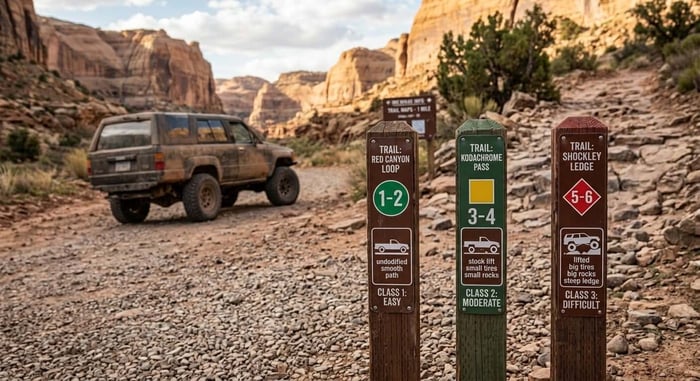
Match your kit to your trip length, your distance from help, and the terrain you're running. A weekend on a well-traveled forest road has different requirements than a three-day route through remote BLM land. Know which one you're doing.
Sleep
Getting sleep right is the foundation of an enjoyable overlanding weekend trip. Tired overlanders make poor decisions on the trail and miserable camp companions.
Rooftop tent or ground tent — For a weekend trip a ground tent is entirely practical and significantly less expensive than a rooftop tent system. If you already have an RTT, it earns its keep on a two-night trip just as much as a longer one. What matters is that your sleep system deploys quickly, keeps you dry, and is appropriate for the overnight temperatures at your destination.
Sleeping bag and pad — Match your bag's temperature rating to the expected overnight low at your destination, not the daytime high. Temperatures drop significantly at elevation and in shoulder seasons. A quality sleeping pad — foam or inflatable — adds warmth from below and comfort that a sleeping bag alone can't provide.
Pillow — Bring one. It's not heavy and it makes a real difference.
Kitchen and Cooking
A weekend overlanding trip doesn't require a full camp kitchen — but eating well makes the experience significantly more enjoyable. Here's what actually fits and gets used:
Partner Steel camp stove — Partner Steel's aluminum two-burner system is compact enough for a weekend kit and capable enough to cook real meals. Two burners lets you run a pot of water and a pan simultaneously — the minimum for cooking anything worth eating at camp. Their aluminum construction keeps weight down without sacrificing durability.
Square Cookware — Square Cookware's stackable system is purpose-built for exactly this scenario. Pots, pans, and lids nest into a compact stack that takes up minimal space and unpacks into a complete cooking setup. For a weekend trip where space is at a premium and you want to eat well without the chaos of mismatched gear, Square Cookware solves the problem cleanly.
Madkon Braai — If a campfire is part of your weekend plan, a Madkon Braai is worth the space it takes. This South African-style portable grill travels compactly, sets up quickly, and delivers camp meals that a gas stove simply can't — the kind of fire-cooked food that makes a base camp feel like a real destination rather than a rest stop.
Coffee setup — Non-negotiable for most overlanders. A simple pour-over or percolator adds minimal weight and significantly improves morning camp morale. Bring more coffee than you think you need.
Cutting board, knife, camp utensils — One of each. Keep it simple.
Trash bags — Leave No Trace means packing out everything you pack in. Bring more bags than you think you need.
Water
Water management is where most weekend overlanders under-prepare. Here's the math: plan for a minimum of one gallon per person per day for drinking and cooking. Add more if you're in a hot climate, doing strenuous activity, or want water for basic washing up.
For a two-person weekend overlanding trip that's a minimum of six gallons — more is better. Quality jerry cans mounted to your rack or in your bed are the most practical storage solution for a weekend trip. A filtration system — a quality water filter or purification tablets — gives you backup options if you're camping near a water source.
Kakadu Portable Shower — Even on a short weekend trip, a portable shower changes the experience. A quick rinse after a dusty trail day or a wash-up before cooking is the difference between feeling like you're camping and feeling like you're roughing it. Kakadu's pressurized portable shower is compact, easy to use, and earns its place in a weekend kit.
Hygiene and Sanitation
Wrappon Portable Toilet — On trails and camp sites without restroom facilities, a Wrappon self-sealing portable toilet is the most practical and Leave No Trace-compliant solution available. Each use wraps and seals automatically — no odor, no cassette, no chemicals. For a weekend trip it takes up minimal space and removes one of the more logistically awkward aspects of remote camping. Bring one.
Biodegradable soap — One bottle handles dish washing, hand washing, and personal hygiene. Make sure it's biodegradable for use near water sources.
Microfiber towels — Compact, fast-drying, and multi-purpose. Two per person is plenty for a weekend.
Hand sanitizer and wet wipes — Trail hands between water sources. More useful than you think.
Toilet paper and trowel — For when the Wrappon isn't the right tool for the job. Always pack out used TP.
Power and Lighting
ICECO Portable Fridge — For a weekend overlanding trip an ICECO fridge running off your vehicle's 12V system or a small auxiliary battery keeps food and drinks cold without ice management. The difference between a cooler and a fridge on a warm weekend is significant — no drainage, no soggy food, and drinks that are actually cold when you want them. ICECO's smaller units are perfectly sized for a two to three day trip for two people.
Headlamps — One per person, with fresh batteries. Headlamps are more useful than lanterns for most camp tasks because your hands stay free.
Camp lantern — One quality lantern for the table or communal camp space. LED lanterns are lightweight and run for hours on a set of batteries.
Phone and device charging — A small power bank handles phone and device charging for a weekend trip without needing a full auxiliary power system. If you're running a fridge, a basic auxiliary battery setup manages both.
Navigation and Communication
Garmin inReach — On any overlanding trip into terrain without reliable cell coverage, a Garmin inReach satellite communicator is the most important safety tool you can carry. Two-way messaging, GPS tracking, and SOS capability work anywhere on earth. For a weekend trip two hours from home it might feel like overkill — until you need it. Carry one.
Downloaded offline maps — Cell coverage in trail areas is unreliable. Download your route and surrounding area in Gaia GPS or OnX Offroad before you leave. Don't rely on live data when you're off the pavement.
Compass and paper map — Backup navigation for when devices fail. Know how to use them.
Recovery Gear
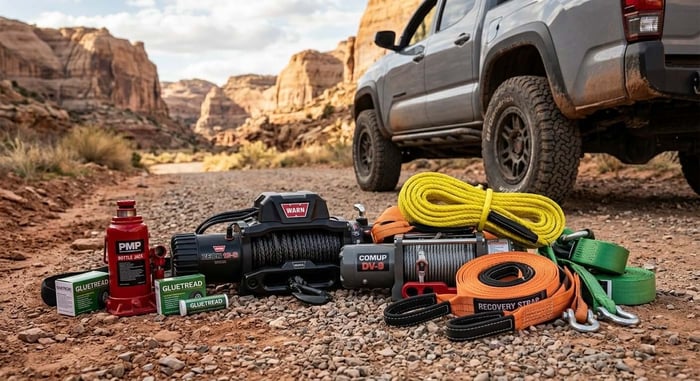
Even on a weekend overlanding trip on moderate terrain, a basic recovery kit is non-negotiable. At minimum carry:
- Kinetic recovery strap (Bubba Rope)
- Two rated shackles
- Traction boards (Maxtrax)
- PMP hydraulic bottle jack
- Tire plug kit and inflator
- Gluetread sidewall repair kit
- Gloves and a small shovel
A winch is ideal but not always practical for every build. If you're traveling without one, the strap and traction boards cover the most common recovery scenarios on moderate weekend terrain.
What to Leave Home
This is where most first-timers go wrong. Here's what experienced overlanders have learned to leave behind:
The full tool kit. A basic trail toolkit — tire plugs, a multi-tool, zip ties, duct tape, spare fuses, and a few common hand tools — covers 95% of field fixes. The full rolling tool chest stays home.
Every piece of clothing you own. Two to three days requires three to four sets of clothes depending on how muddy you get. Layer for temperature range, pack one extra set, and leave the rest. Merino wool base layers compress small and handle temperature swings well.
Duplicate gear. One cutting board. One set of cookware. One lantern. Resist the urge to bring backups of things that are unlikely to fail.
Gear you've never used before. A weekend trip is not the time to field-test brand new equipment you don't know how to operate. Practice at home first.
Food for an army. Plan meals intentionally — breakfast, lunch, dinner for each day, plus snacks. Overbuying food adds weight and generates trash. Simple, calorie-dense meals that cook in one or two pots are the overlanding standard for good reason.
The Weekend Packing List — Summary
| Category | What to Bring |
|---|---|
| Sleep | Tent or RTT, sleeping bag, pad, pillow |
| Kitchen | Partner Steel stove, Square Cookware, Madkon Braai, utensils, coffee setup |
| Water | Minimum 1 gal/person/day, jerry cans, filter |
| Hygiene | Kakadu shower, Wrappon toilet, biodegradable soap, towels, wipes |
| Power | ICECO fridge, headlamps, lantern, power bank |
| Navigation | Garmin inReach, offline maps, compass |
| Recovery | Bubba Rope, shackles, Maxtrax, PMP jack, tire repair kit |
| Clothing | 3–4 sets, layers for temp range, rain layer |
| Leave No Trace | Trash bags, trowel, pack-out supplies |
Bottom Line
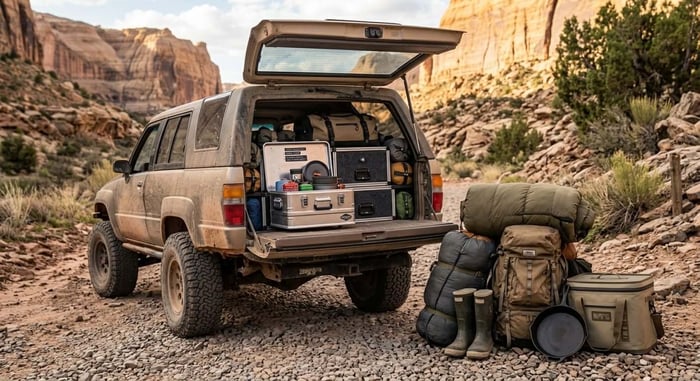
A well-packed weekend overland kit fits in one vehicle, covers every realistic need, and doesn't leave you white-knuckling around corners because you're carrying three times what you actually need. Start with sleep, safety, and water — everything else builds from there. Use the brands that earn their place on repeated trips and leave the rest at home.
At OK4WD we carry everything on this list — from Partner Steel stoves and Square Cookware to ICECO fridges, Kakadu showers, Wrappon toilets, Maxtrax boards, Bubba Rope, and Garmin inReach communicators. Stop into our Stewartsville location or give us a call — we love helping overlanders put together their first kit or refine one that's gotten too heavy.
OK4WD has been equipping Jeeps and trucks for adventure since 1979. Browse our overland gear inventory or talk to our team about building your weekend kit.
FAQs
How much does a basic weekend overland kit cost?
A functional weekend kit — tent, basic kitchen, water storage, recovery basics, and communication — can come together for $1,500–$3,000 depending on brand choices and what you already own. Premium gear across all categories runs higher. Build gradually rather than buying everything at once.
Do I need a rooftop tent for overlanding?
No — a quality ground tent works well for weekend trips and is significantly more affordable. An RTT earns its value on frequent trips and multi-day expeditions where fast setup and off-ground sleeping matter most.
How do I manage food on a weekend overland trip?
Plan meals before you leave. Simple one-pot or two-pot meals — pasta, rice dishes, eggs, grilled meat on the Braai — are practical and satisfying. Pre-chop vegetables at home to reduce camp prep time. The ICECO fridge makes fresh food viable for a full weekend without ice management.
What's the most important thing to bring that first-timers forget?
A headlamp with fresh batteries. It sounds obvious until you're trying to set up camp in the dark or find something in your kit at 2am.