How to Choose Wheels for Off-Road: Offset, Backspacing & Sizing Explained
Wheels are one of the most visible upgrades on any off-road build — but they're also one of the most technical. Get the sizing right and your rig looks and performs exactly the way you envisioned. Get it wrong and you're dealing with rubbing, poor handling, accelerated bearing wear, and a build that never quite comes together. This guide breaks down the key measurements that matter, what they mean for your build, and how to choose wisely.
Why Wheel Fitment Is More Than Aesthetics
Most people start the wheel conversation thinking about looks — finish, spoke pattern, color. Those things matter, but they're the last decision you should make, not the first. Before you choose a style you need to understand three numbers that determine whether a wheel actually fits your vehicle correctly: diameter, width, and offset. Get these right and the aesthetic choices are easy. Get them wrong and no amount of style saves the build.
Wheel Diameter
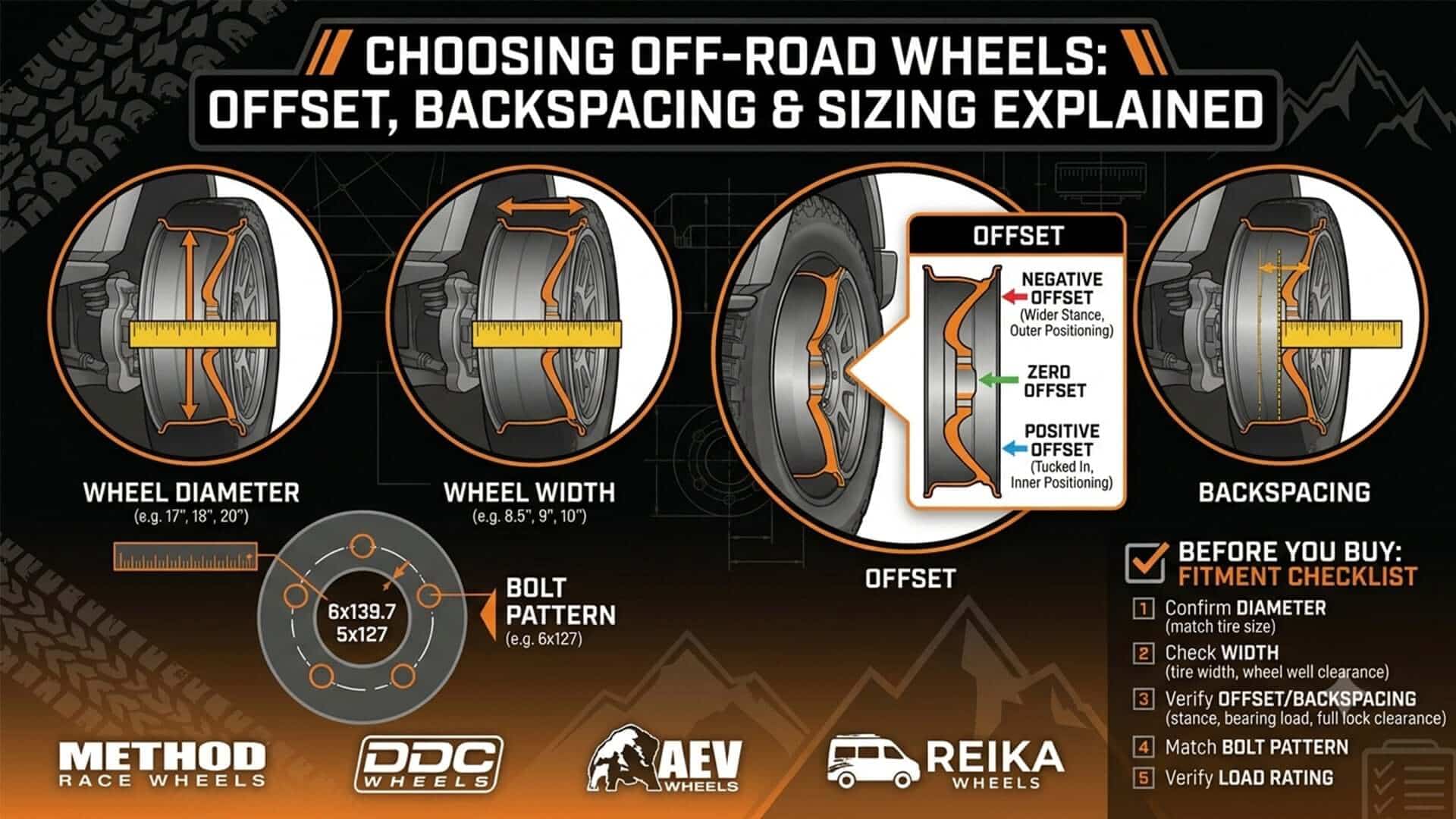
Wheel diameter is the measurement across the wheel from bead seat to bead seat — the number in your tire size that follows the slash (e.g., the "17" in 35x12.50R17). For off-road builds, 17" wheels are the most popular choice and for good reason: they leave more sidewall on your tire, which means more cushion, better flex, and improved puncture resistance on the trail. Larger diameter wheels — 18", 20" — look aggressive and are common on street-oriented builds, but the reduced sidewall height that comes with them works against you off-road.
For most serious off-road and overland builds, 17" is the sweet spot. If you're running a leveling kit or modest lift on a daily driver that sees occasional trails, 18" can work well. Beyond that, the tradeoffs lean away from trail performance.
Wheel Width
Width determines how much tire you can run and how that tire sits in the wheel well. Off-road wheels typically run 8" to 10" wide, with 8.5" and 9" being the most common for trail and overland builds.
A wider wheel allows a wider tire to sit properly without ballooning — a 12.5"-wide tire on a narrow wheel will bulge outward and wear unevenly. But width has limits too: too wide and you're fighting your fender flares, rubbing on full lock, and pushing bearing loads beyond their design range. Matching wheel width to your tire width and your vehicle's wheel well dimensions is a critical step that's easy to get wrong if you skip the research.
Offset — The Most Misunderstood Measurement
Offset is the distance between the wheel's mounting face — where it bolts to the hub — and the wheel's centerline. It's measured in millimeters and expressed as positive, zero, or negative:
Positive offset means the mounting face is toward the outside of the wheel — the wheel tucks inward toward the vehicle. Factory wheels on most modern trucks and SUVs run moderate positive offset.
Zero offset means the mounting face is exactly at the centerline.
Negative offset means the mounting face is toward the inside of the wheel — the wheel pushes outward, away from the vehicle. Most aftermarket off-road wheels run negative offset, which widens the stance, improves stability, and allows for larger tires without clearance issues inside the wheel well.
The tradeoff with aggressive negative offset: it increases the lever arm on your wheel bearings, which can accelerate wear over time. Going too negative — beyond what your platform is designed to handle — shortens bearing life meaningfully. Quality aftermarket wheels are engineered with platform-appropriate offset ranges that balance stance and bearing longevity. When in doubt, stay within the manufacturer's recommended offset range for your vehicle.
Backspacing
Backspacing is a related measurement that's sometimes used interchangeably with offset but describes something slightly different: it's the distance from the wheel's mounting face to the inside edge of the wheel. Backspacing and offset convey the same information about wheel position — knowing one lets you calculate the other — but backspacing is more commonly referenced in the Jeep and truck community when discussing fitment clearance inside the wheel well.
Lower backspacing pushes the wheel outward. Higher backspacing tucks it inward. For lifted trucks and Jeeps running wider tires, lower backspacing is typically preferred to keep the tire from rubbing on suspension components at full droop or full steering lock.
Bolt Pattern
Bolt pattern — the number and spacing of the lug holes — must match your vehicle's hub exactly. Most domestic trucks run a 6-lug pattern (6x135 for Ford, 6x139.7 for GM and Toyota) while Jeep Wranglers run a 5x127 pattern. This is non-negotiable — the wrong bolt pattern simply won't fit.
The Brands We Carry
Choosing the right brand matters as much as choosing the right specs. At OK4WD we carry wheels from manufacturers we trust across a range of builds and budgets:
Method Race Wheels — Method is one of the most recognized names in off-road wheels and for good reason. Their designs are proven in competition and built for real-world trail use. The Standard 301 and Mesh 305 are among the most popular off-road wheel designs on the market — clean, aggressive, and available across a wide range of fitments. Method's finish durability and quality control are consistently strong, making them a reliable choice across platforms.
DDC Wheels (Dirty Dick Cepek) — DDC brings an aggressive aesthetic with solid construction credentials behind it. Their wheel lineup is designed specifically for the off-road market with fitments that work well on lifted trucks and Jeeps running larger tire packages. A strong choice for builds that prioritize a bold, trail-focused look with reliable hardware backing it up.
AEV Wheels — AEV's wheel lineup reflects the same platform-specific engineering philosophy behind their suspension systems. Designed exclusively around Jeep fitments, AEV wheels are built to work in harmony with AEV lift systems and tire packages — precise offset specs, correct backspacing for Jeep wheel wells, and construction quality that holds up under serious use. For Jeep builds running AEV suspension, keeping wheels in the family makes engineering sense.
Reika Wheels — Founded in 2020 and based in Chino, California, Reika has established themselves quickly as a brand worth paying attention to. Their flow-form manufacturing process stretches and shapes the aluminum wheel skirt to produce a wheel that's lighter than a cast unit while maintaining improved grain structure and strength — a meaningful engineering advantage for off-road use where unsprung weight directly affects trail feel. Reika's attention to detail extends to features like the Teton's built-in rim gaps that protect valve stems from rock strikes — the kind of trail-specific thinking that separates purpose-built off-road wheels from street wheels with aggressive styling. They also developed the first Super Single wheel setup for the Mercedes-Benz Sprinter 3500, allowing 3500 vans to replace their dual-rear-wheel dually configuration with a cleaner, more capable single wheel setup — a standout innovation for the van life and overland van community.
Putting It Together — A Simple Fitment Checklist
Before finalizing any wheel purchase, confirm the following:
- Diameter matches your tire size and build goals (17" for most off-road builds)
- Width is appropriate for your tire width and wheel well dimensions
- Offset falls within the recommended range for your platform
- Backspacing clears your suspension components at full droop and full steering lock
- Bolt pattern matches your vehicle's hub exactly
- Load rating meets or exceeds your vehicle's requirements
If you're unsure about any of these — particularly offset and backspacing — a five-minute conversation with a knowledgeable installer can save you from an expensive mistake.
Bottom Line
Wheel fitment is a technical decision that pays off when done right and costs you when done wrong. Start with diameter, width, and offset — get those numbers dialed in for your platform and your tire package before you think about aesthetics. Then choose from brands that build wheels for actual off-road use: Method, DDC, AEV, and Reika each bring something different to the table and between them cover nearly every build type we see at OK4WD.
Stop into our Stewartsville location or give us a call — we'll help you match the right wheel to your build, your tires, and your budget.
OK4WD has been building trucks and Jeeps since 1979. Browse our wheel inventory or schedule a consultation with our team.
FAQs
Can I run any offset I want if I use wheel spacers?
Wheel spacers can correct offset but introduce their own engineering considerations — they add a failure point and further increase the lever arm on your wheel bearings. Quality hub-centric spacers from reputable manufacturers are acceptable for modest corrections, but they're not a substitute for choosing the correct wheel offset from the start.
Does wheel weight matter for off-road use?
Yes — unsprung weight (weight not supported by your suspension) directly affects how well your suspension tracks the terrain. Lighter wheels allow the suspension to react faster to trail obstacles, improving traction and reducing fatigue on components. Flow-formed wheels like Reika's offer a meaningful advantage here over heavier cast alternatives.
How do I know if a wheel will rub after installation?
The best approach is to confirm offset and backspacing specs with your installer before purchasing. On lifted vehicles, rubbing is most likely to occur at full steering lock and full suspension droop — a test drive on uneven terrain after install will reveal any clearance issues before they become problems.
Should I match my wheel brand to my suspension brand?
Not necessarily — but for Jeep builds running AEV suspension, AEV wheels are engineered to work together and simplify the fitment decision. For other platforms, choosing wheels from a reputable manufacturer with correct fitment specs for your vehicle is more important than brand matching.