Do you want to significantly increase your traction off-road for free? This tip isn't a secret but it is one that most people new to off-roading do not know about. This free and essential tip that increases your traction off-road is called airing down. Airing down is an offroading term that simply means to deflate your tires.
Airing down increases your traction by giving your tire a larger contact patch, more sidewall deflection to conform around rocks, and a smoother, more comfortable ride. Lower tire pressure offroad also aids to longer longevity of your suspension system since the aired down tires work as a cushion that helps keep your suspensions components less overworked and stressed.
To aid in the process of tire deflation and inflation, air tools such air compressors, tire deflators, and tire inflators are essential to offroading. In this overview of tire pressure and air solutions offroad, you will learn about these important tools offroad tools and much more to reinforce your offroad knowledge!

In this Overview, We Will Go Over the Following Topics:
- Important safety notes about tire pressure
- What is TPMS (Tire Pressure Monitoring System)
- What's a Tire Gauge
- How airing down increases traction off-road
- How low to go when airing down
- What are tire deflators
- How to use an E-Z deflator
- Airing back up with tire inflators
- What are tire inflators
- What are air compressors
- How to use a Digital Air Inflator
Important Safety Notes About Tire Pressure
Before we jump into airing down offroad, its is important to understand how tire pressures affect your vehicle. Having the correct tire pressure, whether on or off road, is important to maintaining the safety and performance of your vehicle in either situation. The tire pressure of your tires impact the how your vehicle steers and handles.
On road, your tires should be appropriately aired to the specifications of your car's manufacturer. The recommended PSI ensures optimal performance and safety because that your vehicle's systems, such as its steering, braking, and suspension systems, are working as they were designed. Car Talk provides a good explanation on why incorrect tire pressure can be dangerous on road.
On the flip side, when off road, low tire pressure is a positive and can provide you a great advantage in traction and ride comfort.

Tire Pressure Monitoring System
A system that you should become familiar with us your TPMS or Tire Pressure Monitoring System. TPMS is a federally mandated system that illuminates when your tires are beyond the threshold of what the vehicle manufacturer allows for that vehicle. Every vehicle newer than 2008 must have this system installed by car manufacturers.
We mention TPMS because when you air down to go off-roading, your TPMS light will be illuminated. It is not an issue if you air down and are going at slow speeds off-road.
If your TMPS light illuminates when your on road or you're wanting to know the pressure of your tires before you go off road, you can check your tires' pressure using a tire gauge.


What is a Tire Gauge?


A tire gauge is a device to measure your tires' pressure. ARB's offers Red Small Dial Pressure Gauge (ARB506) and a Large Tire Pressure Gauge (ARB508). The Large Gauge is is specifically for lower tire pressure amounts in context to offroading and measures in 5 PSI increments and maxes out at 50 PSI. You can also check you tire pressure using a tire deflator or inflator.
How and Why Airing Down Increases Traction Off-Road
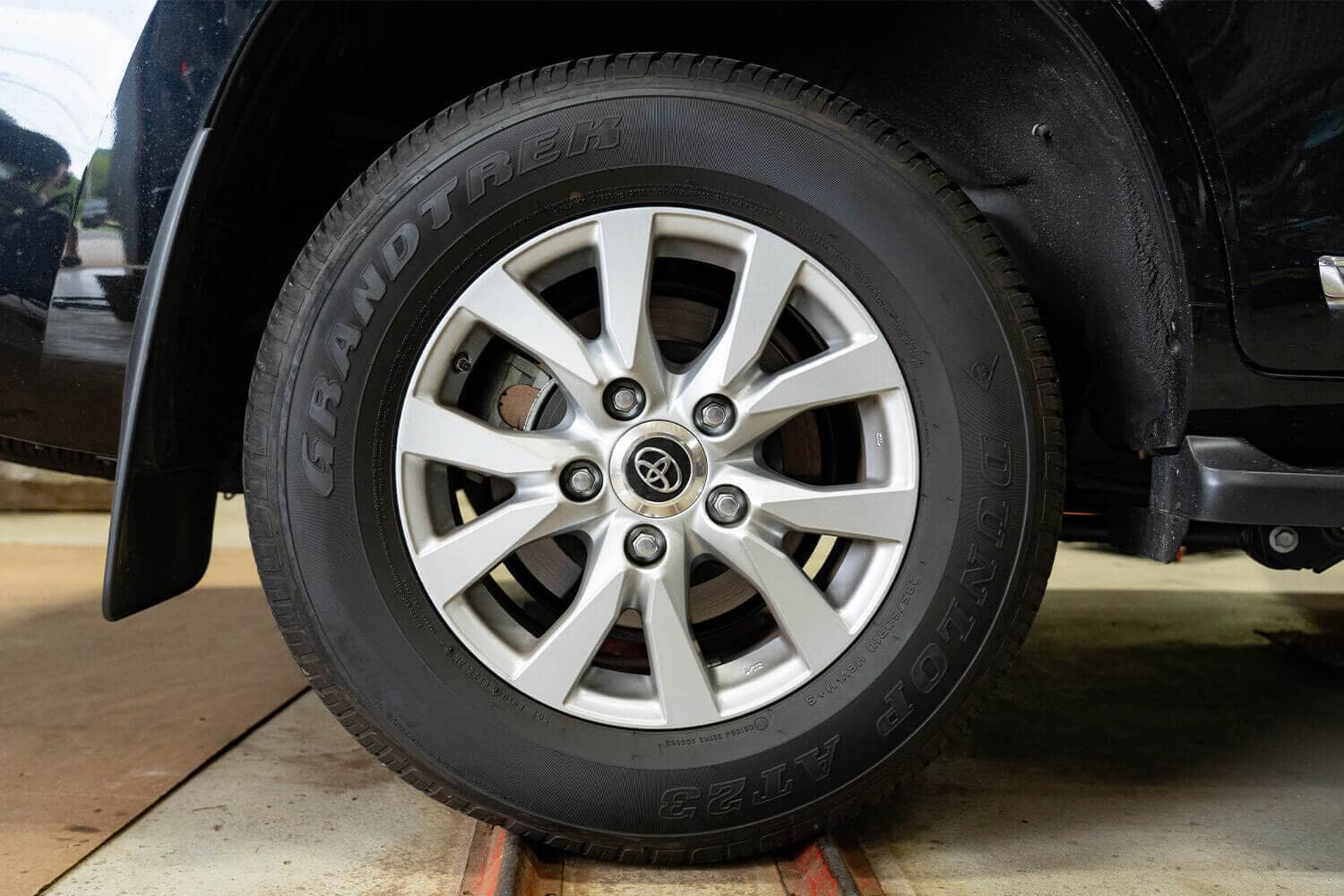
Though dangerous on road and at high speeds, aired down tires are essential to driving off road and is one of the easiest ways to increase your vehicle's offroad traction. Lower the pressure the more surface area of the tire to grip the terrain.

Whether driving in snow, mud, rocks, or sand, aired down tires could be the difference between getting pass an obstacle or spinning your tires. The three biggest benefits of airing down your tires include: larger contact patch, better sidewall deflection, and a smoother ride.
How Low To Go When Airing Down
How much should you air down? This is an excellent question and you should only lower your pressure as much as you need. It depends on the vehicle, how much weight you've added by equipping it for off-road and overland travel, and the terrain you are on but the general rule of thumb is to lower your air pressure to 20 PSI. If you find you need more traction, you can further lower it but do not go lower than 15 PSI. If you go lower than 15 PSI on a standard wheel, you increase the risk of de-beading the tire from the wheel which will render that wheel and tire unusable unless you can get the tire professional re-mounted or perform a repair in the field.
If you have beadlock wheels, you start at 10 PSI and air down further if necessary.
What Are Tire Deflators
Tire deflators are a tool that allows you to quickly and, more importantly, accurately air your tires down to a specific tire pressure.
Its important that you invest in a quality tire deflator as you're paying for the accuracy of the gauge. It may not seem like a lot, but the difference between 18 PSI and 12 PSI is a lot drastically increases the risks of de-beading the tire.
Pressure Ranges
Tire deflators have a range of operation and its important you get one that will work for your application.
Different Types of Tire Deflators
Pre-set Screw Ons Tire Deflators:

Coyote | Tire Deflators 
Teraflex | Air Deflator (#4807200)
These kinds of deflators come in sets of four and can be pre-set to a tire pressure at 30 down to 6 psi. These deflation devices work by setting each at the same psi. After this is done, each device (four total) is individually screwed on to each valve of your four tires.
A downside of this type of deflator is that it will not let air out of your tires quickly, however, the upside is that all four tire deflators are releasing air at the same time. If needed, the vehicle can also be driven while deflating air but only at very low speeds. Ultimately, for the best results, it is best to wait until the desired psi is reached before setting off on the trail.
Fast or E-Z Tire Delfators:

Unlike pre-set screw on deflators, EZ Tire deflators are incredibly fast and can deflate tires up to 1 psi per second. This fast deflation is achieved by removing the inner valve. Unlike pre-set screw deflators, this device can only deflate one tire at a time, however, the rapid release of air mitigates this demand. When deflating with this device, remember to check your pressure frequently as it is easy to let too much air out.
ARB offers an EZ Tire Deflator and a ARB EZ Digital Deflator. Teraflex and AEV also carry their own EZ Tire Deflators. You can learn how to use one of these devices in our Learn How to Use an EZ Tire Deflator Blog Post.


Primitive Tire Defators:
If without a deflator on hand, you can always bleed air from your tires using by using stick or stone to depress the valve stem. This practice is effective in releasing air, but not accurately or precisely. In addition, the speed of air release will be synonymous to the rate of pre-set screw deflators, which is slow. However, instead of deflating all four tires at once, you can only deflate one tire at a time. For the price, convenience, and accuracy, buying a dedicated tire deflator for your rig is a must have in your arsenal of offroad equipment.
How to Use a E-Z Tire Deflator
- Secure EZ Tire Deflator to the Tire Valve using the middle knob to screw (turn clockwise/right) the deflator to tire valve.
- Turn the outer knob clockwise/right until it snaps. This means that it is holding the valve stem. After you hear the snap, turn the same knob counter-clockwise/left until the valve is completely removed from the wheel and pull the stem toward you.
- At this point you can either deflate your tires by pulling the inner knob toward you or check your pressure by pushing it away from you.
- Once your tires are at your desired pressure, you can remove the EZ Tire Deflator and secure you tire valve by reversing the steps above.


If without a deflator on hand, you can always bleed air from your tires using by using stick to depress the valve stem. This practice is effective in releasing air, but not accurately or precisely. For the price, buying a dedicated tire deflator for your rig is a must have in your arsenal of offroad equipment.
What are tire inflators
Tire inflators are devices used to inflate your vehicle's tires. They can be stand alone inflators or inflation adaptors that work in conjunction with your portable or on-board air compressor.
Stand-Alone Tire Inflator
Seeing the TPMS turn on for deflated tires can be a distressing situation to deal with when you are alone or in a hurry. A stand alone tire inflator that does not use the aid of an air compressor is great for emergencies and the average commuter. Many work on 12 vt accessory outlet in your car and can be set to shut off to your desired PSI, so all you have worry about is hooking the device up properly to a power outlet and your tire stem.
Inflation Adapters
Inflation adapters, also known simply as tire inflators, are adapters used in conjunction with an air compressor [link to air compressor article] to inflate your tires.
Having a dedicated air compressor- whether a portable or on-board model- can have many benefits, like powering pneumatic tools and air lockers, in addition to tire inflation. If your are more than just an average commuter and offroad often, then you should consider buying a dedicated air compressor for your vehicle, You can learn more about air compressors HERE [insert air compressor link].

ARB | Digital Tire Inflator 
ARB | Tire Inflator with Gauge
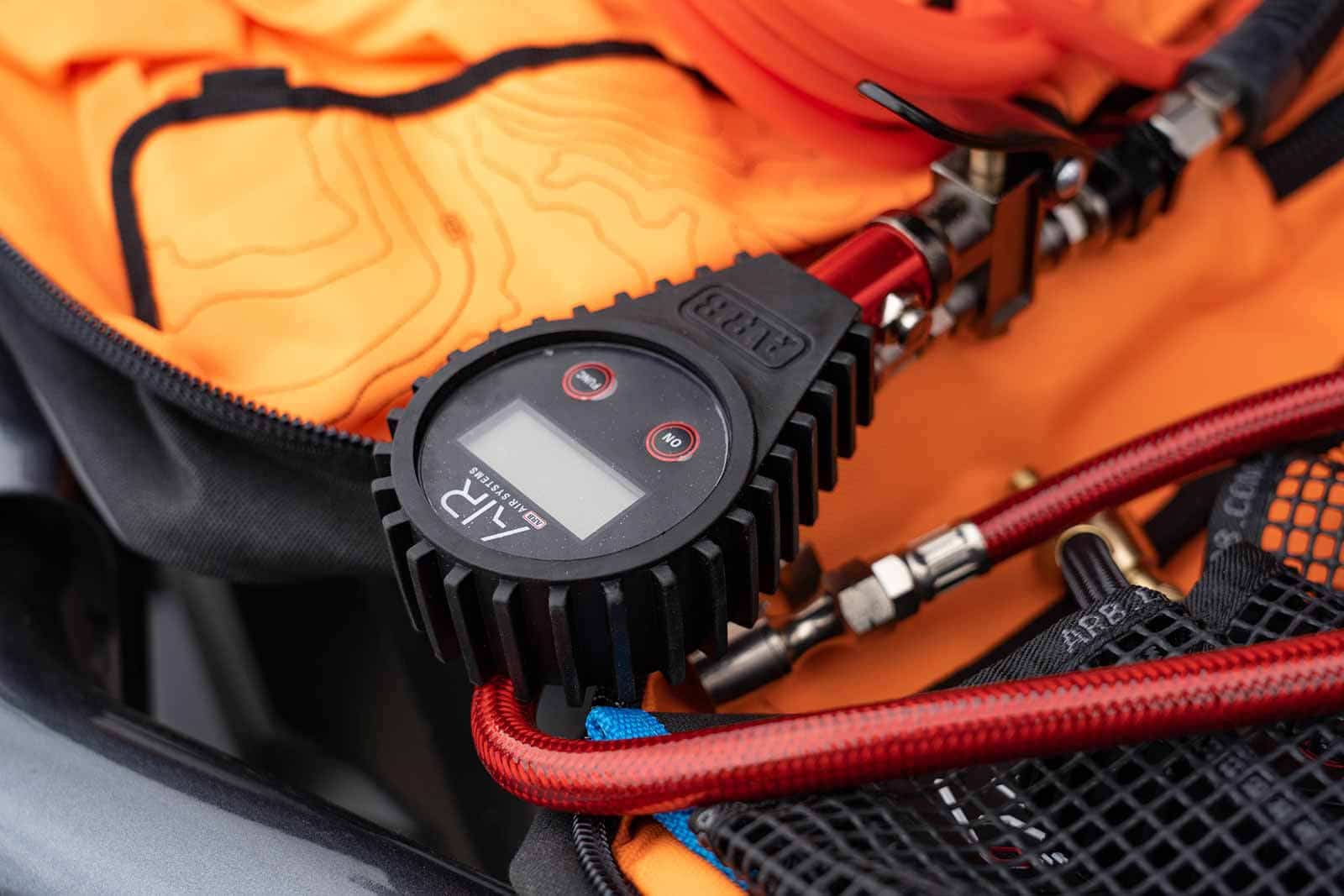
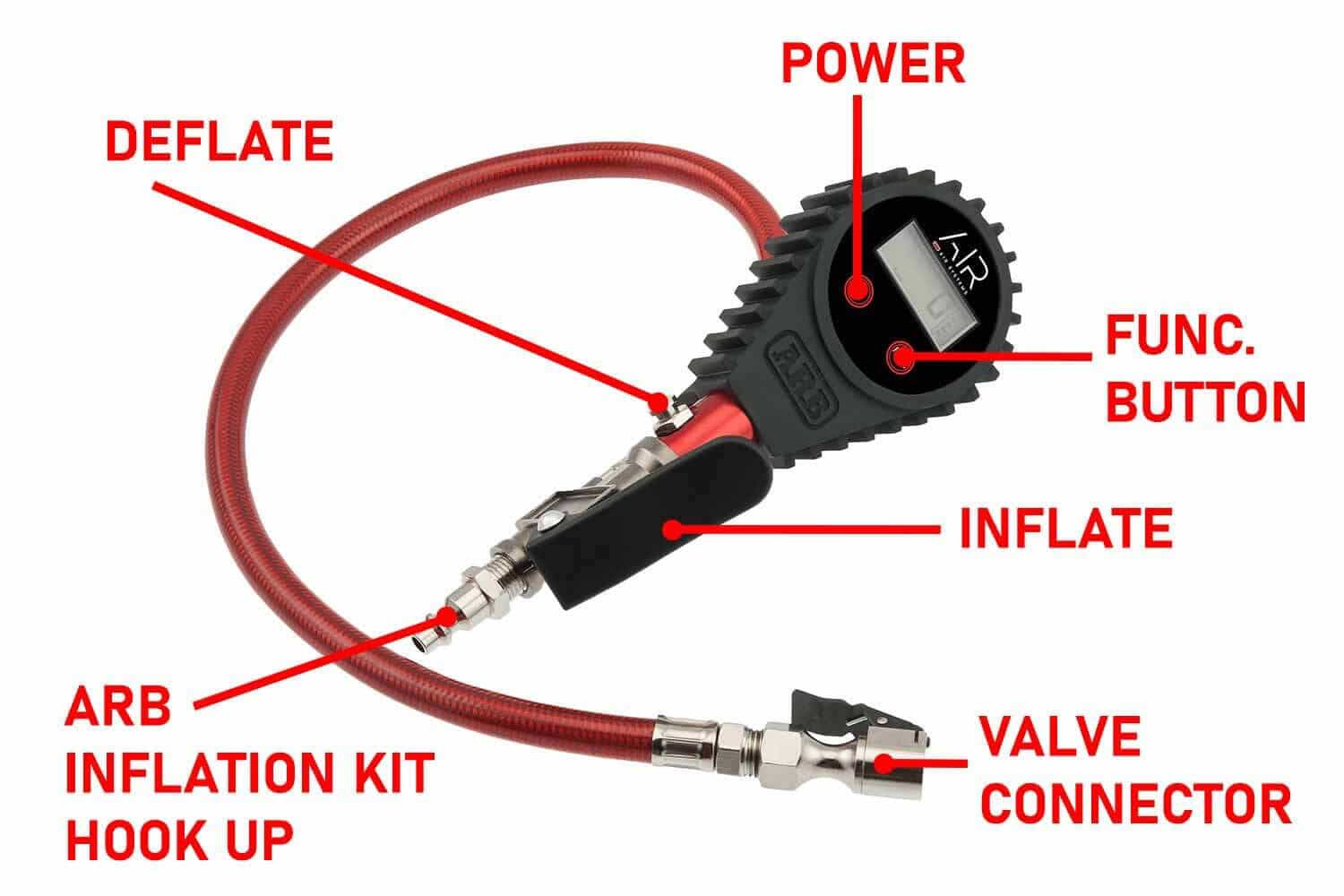
ARB carries a Digital Tire Inflator Braided Hose w/ Chuck and Tire Inflator with Gauge. Both are excellent tools to get the job done. The major differences between the two is one is digital gauge and the other is an analog. Digital verse analog deals with personal preference and price range of the consumer (the digital inflator is twice the cost of the analog inflator). It does not change the accuracy of the pressure reading.
Another difference to note is the length of the braided hose that connects your inflator to your tire valve. On the the digital inflator, the PVC braided hose is 23.5" long, wheres the stainless steel braided hose on the analog inflator only reaches to 13". This many be an issue if you don't want to be bending over to inflate your tires.
Required Inflation Accessories


Required with these ARB Inflator Adaptors, is an ARB Air Compressor and a ARB Tire Inflation Kit. The ARB Inflation kit consists of:
- 1 x High heat pressure hose
- 1 x ARB air chuck with quick press fitting
- 1 x ARB T-fitting for use with the CKMA12 ARB air compressor
What are air compressors
An air compressor is a mechanical device that increases the pressure of a gas by decreasing its volume. The potential energy of the compressed air is stored by being forced into a storage tank. In the case of inflating your tires, your tires act as the storage tank.
Different Kinds and Classifications of Air Compressors
There two main kinds of compressors: dynamic displacement and positive displacement.
Positive displacement compressors will be the kind that you'll use on your vehicle because they are more suited for smaller and portable applications. They work by forcing air into a chamber whose volume is decreased to compress air. The size of the chamber can be decreased through a reciprocating piston mechanism, rotary screw, or rotatory vane.
In addition, to the mechanism used to pressurize air, compressors are also classified by their total discharge pressure or pressure delivered. Compressors are classified in three ways:
- Low Pressure Air Compressors (LPAC), which have a discharge pressure of 150 psi or less
- Medium Pressure Air Compressors, which have a discharge of 150 psi - 1000 psi
- High Pressure Air Compressor (HPAC), which have a discharge greater than 1000 psi
What compressor should I get for my vehicle?


We highly recommend ARB's line of air solutions. They are the gold standard of on-board air needs. Whether you are inflating tires, operating pneumatic tools, or simply providing air to an Air Locker, the complete line of ARB compressors has a model to fit every need.
ARB offers a High Output Air Compressor and a High Output Twin Air Compressor, which are but available in portable and vehicle mounted configurations.