How and Why Airing Down Increases Traction Off-Road
Though dangerous on road and at high speeds, aired down tires are essential to driving off road and is one of the easiest ways to increase your vehicle's offroad traction.
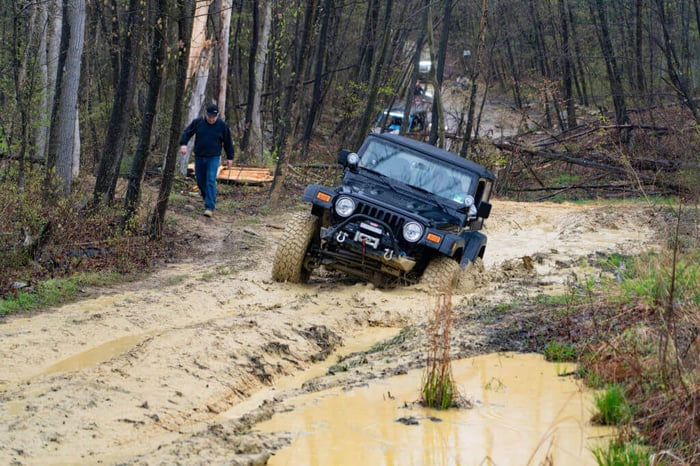
Whether driving in snow, mud, rocks, or sand, aired down tires could be the difference between getting pass an obstacle or spinning your tires. The three biggest benefits of airing down your tires include: gaining a larger contact patch, better sidewall deflection, and overall smoother ride.
In this Article, we will go over:
- Larger Contact Patch
- Allows for Better Sidewall Deflection
- Smoother Ride/ Easier on Suspension Components
- How Low to Go When Airing Down

Larger Contact Patch
Lower the pressure in your tire, the more surface area of the tire or contact patch to grip the terrain. A contact patch is the area where your tire contacts the ground. Simply speaking, your vehicle's four contact patches create traction for your engine to apply its power and propel the car forward.
Allows For Better Sidewall Deflection
Besides just allowing for a larger contact patch, sidewall deflection allows your tire to better form around obstacles such as rocks which aids immensely in traction.
For example, imagine if your tires were fully inflated. A rock hard tire is not going to do well against a rock that is equally as rigid because the rubber has no room to give. Instead, a drop in pressure- even as small as 5 PSI- to soften your tire allows it to hug the obstacle and use it to its advantage.
Smoother Ride / Easier On Suspension Components
Another benefit to airing down is ride quality off-road. Driving off-road can be exceptionally rough and bumpy and by airing down, it allows your tires to flex more and your suspension components to work less.
How Low To Go When Airing Down
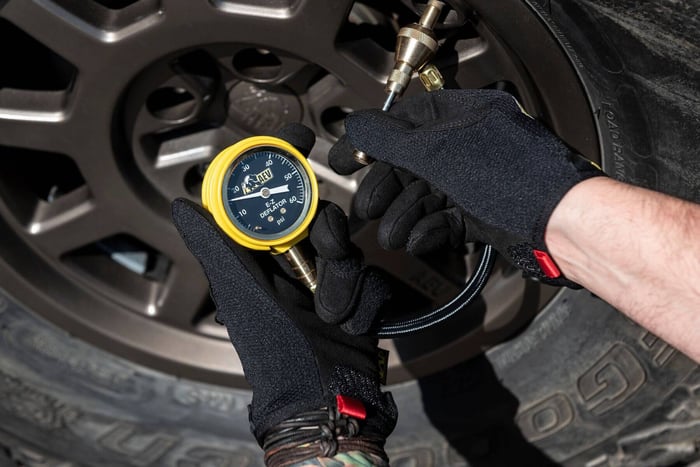
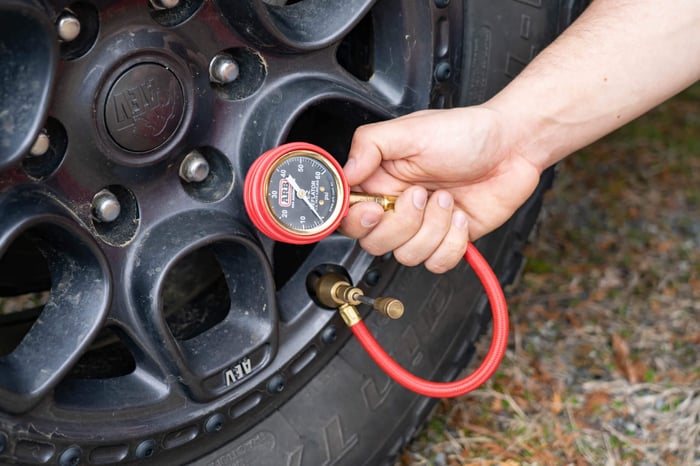
How much should you air down? This is an excellent question and you should only lower your pressure as much as you need. It depends on the vehicle, how much weight you've added by equipping it for off-road and overland travel, and the terrain you are on but the general rule of thumb is to lower your air pressure to 20 PSI. If you find you need more traction, you can further lower it but do not go lower than 15 PSI. If you go lower than 15 PSI on a standard wheel, you increase the risk of de-beading the tire from the wheel which will render that wheel and tire unusable unless you can get the tire professional re-mounted or perform a repair in the field.
If you have beadlock wheels, you start at 10 PSI and air down further if necessary.