The Complete ARB Ecosystem — How the Products Work Together
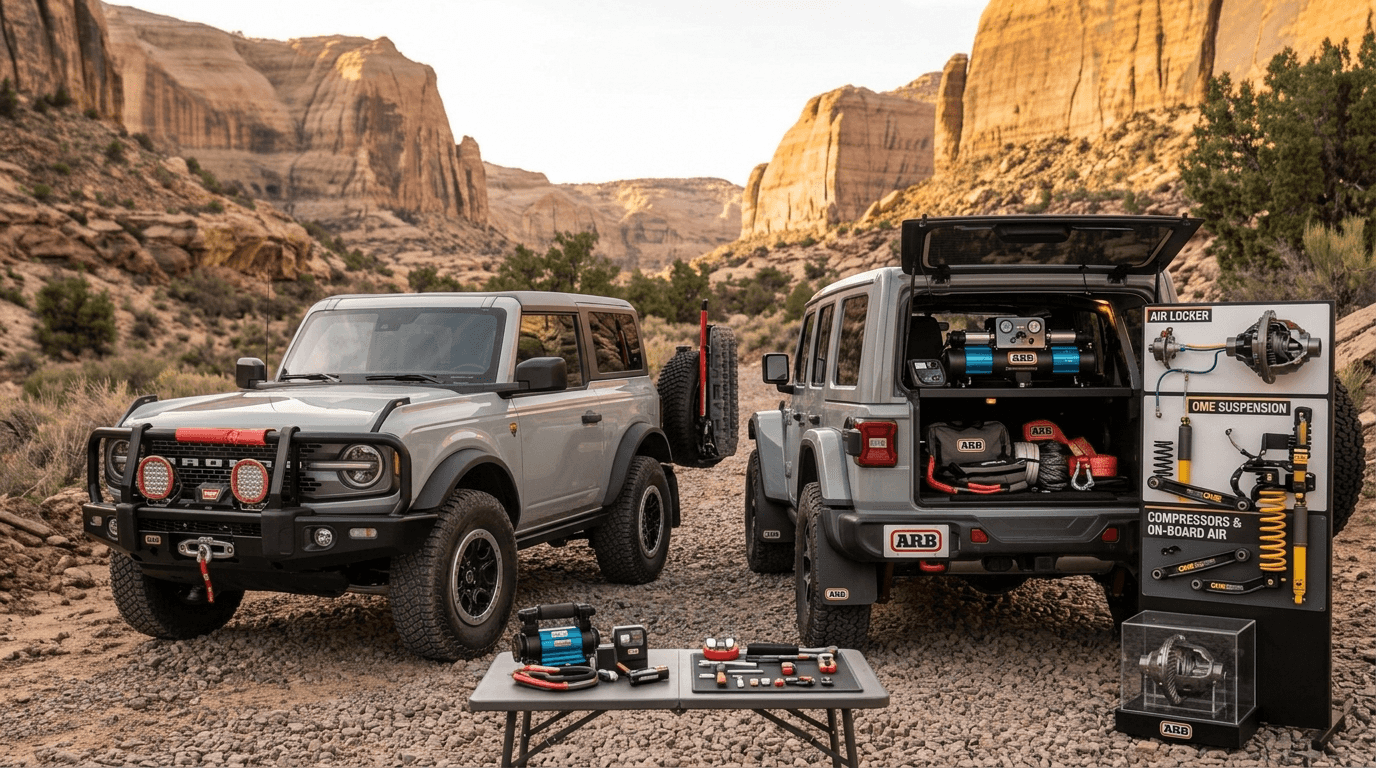
Most ARB customers start in one place — a set of Old Man Emu shocks, a front bumper, or a pair of Air Lockers — and discover over time that ARB's product lineup is designed to work as a system rather than a collection of individual parts. The air compressor that runs your lockers also airs your tires back up after the trail. The bumper that mounts your winch also integrates with your recovery points. The suspension that lifts your rig is tuned to work with the weight of the protection and recovery gear ARB builds to go with it.
This guide is for ARB customers who already know the brand and want to understand how the pieces connect — and what building a complete ARB system actually looks like.
The Foundation — Old Man Emu Suspension
Every serious ARB build starts with suspension. Old Man Emu is ARB's suspension division and one of the most globally trusted names in off-road suspension engineering. OME suspension is designed around a core philosophy that ARB applies across its entire product line: build for the real-world demands of loaded, built vehicles — not unloaded showroom trucks.
This matters more than it sounds. A suspension system tuned for a stock, unloaded vehicle performs very differently when you add bumpers, skid plates, a winch, recovery gear, and overlanding kit. OME suspension is engineered with that additional weight in mind — spring rates and shock valving are calibrated for vehicles that are actually built out, not just lifted. If you're planning a complete ARB build, starting with OME suspension gives you a foundation that's specifically designed to work with everything that follows.
OME product highlights:
Nitrocharger Sport Shocks — OME's core shock offering. Nitrogen-charged monotube construction delivers consistent damping performance across a wide range of temperatures and terrain types. Available in standard and heavy-duty valving to match your build's weight and use case.
BP-51 Bypass Shocks — OME's premium shock system. Remote reservoir bypass shocks with external adjustment — the performance tier for serious trail and overland builds where the standard Nitrocharger Sport isn't enough. Externally adjustable compression damping lets you tune the ride for the terrain you're running.
Coil Springs and Leaf Packs — OME springs are rated for specific load ranges and designed to work with OME shocks as a matched system. Running OME springs with non-OME shocks — or vice versa — leaves performance on the table. The system is engineered as a unit.
The Muscle — ARB Air Lockers
ARB's Air Locker is one of the most significant off-road innovations of the last 30 years — a selectable locking differential that delivers the traction of a fully locked axle on demand and returns to open differential behavior at the touch of a button.
Understanding why Air Lockers matter requires understanding what a locking differential does. In a standard open differential, power follows the path of least resistance — the wheel with the least traction gets the power. On technical terrain, that means a spinning tire in the air or on ice while the wheel with traction sits idle. A locked differential forces both wheels on an axle to turn at the same speed regardless of traction conditions — dramatically improving capability on loose, rocky, or uneven terrain.
ARB's Air Locker uses compressed air to engage the locking mechanism — delivering instant, on-demand locking that can be engaged and disengaged while the vehicle is moving slowly. This selectability is the key advantage over traditional locked differentials, which lock permanently and create handling problems on paved roads.
Front and rear Air Lockers — Most serious builds run lockers on both axles. A front locker alone improves steering and pulling capability on technical terrain. A rear locker alone improves straight-line traction. Both together deliver maximum capability — the combination that defines a fully capable trail rig.
Platform coverage — ARB Air Lockers are available for a broad range of differentials across Jeep, Toyota, Ford, and Ram platforms. Confirm fitment with your installer for your specific axle configuration.
The Connection — ARB Air Compressors and On-Board Air
Here's where the ARB ecosystem becomes more than the sum of its parts: the Air Lockers require compressed air to operate, and ARB's on-board air compressor lineup is designed specifically to supply that air — along with a range of other functions that make it one of the highest-utility additions to any build.
ARB CKMTA12 Twin Motor Compressor — ARB's flagship on-board compressor and the one most commonly specified for builds running Air Lockers. Twin motor design delivers high flow rate and fast recovery — critical when you need to engage lockers quickly on the trail or air up four tires at the trailhead. Designed for permanent vehicle mount and engineered for the duty cycles that serious off-road use demands.
ARB CKMA12 Single Motor Compressor — The single motor option for builds where the twin's flow rate isn't required or where space is more constrained. Still a quality, purpose-built compressor — a strong choice for builds that prioritize tire inflation over locker operation speed.
What on-board air actually does:
Beyond operating the Air Lockers, an ARB compressor mounted to your vehicle gives you:
- Tire inflation after airing down — Airing down for the trail is standard practice. Airing back up for the road with a quality compressor takes minutes rather than the extended wait of a portable unit.
- Recovery gear inflation — Air-operated recovery tools and inflatable recovery devices.
- Air tools — A properly rated compressor powers air tools for trail repairs — impact wrenches, tire plug tools, and more.
- General utility — Anywhere compressed air is useful, your on-board system delivers it without finding a gas station.
The compressor is the hub that connects the Air Locker system to the broader utility of on-board air — and it's the product that makes the ARB ecosystem function as an integrated system rather than independent components.
The Protection — ARB Bumpers and Bar Work
ARB's steel bumper lineup is designed to do three things: protect the vehicle, mount recovery equipment, and integrate with other ARB components. A well-specified ARB bumper is a functional platform, not just armor.
Front bumpers — ARB front bumpers are engineered around winch mounting — most models include a winch tray rated for the winch sizes appropriate to the vehicle's weight class. Integrated recovery points, auxiliary light mounts, and air line routing for on-board air systems are built into the design. The bumper, the winch, the compressor, and the recovery gear are designed to work together from the same engineering team.
Rear bumpers and bar work — ARB rear protection integrates with recovery points, spare tire carriers, and hi-lift jack mounts. For overlanders running a full ARB system, rear protection that matches the front bumper creates a cohesive, integrated build rather than a collection of mismatched components.
Why bumper weight matters with suspension — A steel front bumper adds 80–150 lbs to the front of your vehicle. This is exactly why starting with OME suspension is the right foundation for an ARB build — the spring rates and shock valving are calibrated to handle the additional nose weight that a full bumper and winch setup creates. Installing an ARB bumper on suspension tuned for a stock-weight vehicle degrades both ride quality and handling.
The Recovery System — ARB Recovery Gear
ARB's recovery gear lineup is among the most trusted in the industry and integrates directly with the bumper and compressor systems described above.
Kinetic recovery ropes and straps — ARB's kinetic ropes deliver the energy-storing recovery performance that makes vehicle-to-vehicle recovery effective. Rated for serious pull loads and built to handle repeated use in demanding conditions.
Snatch blocks and rigging — ARB's rigging hardware is engineered to work with their winch and bumper systems. Snatch blocks that double the pulling power of your winch, tree savers that protect anchor points, and shackles rated for recovery loads — all designed as part of a system.
Recovery boards — ARB's traction board offering provides the mud, sand, and snow recovery capability that completes a self-sufficient recovery kit.
The recovery system in practice: An ARB-equipped rig approaches a recovery situation with a winch mounted to an ARB bumper with integrated recovery points, ARB rigging hardware, and an on-board compressor that can supply air tools if needed during recovery. The system is designed to work together because it was engineered together.
Building an ARB System — A Logical Sequence
For customers who want to build a complete ARB system over time rather than all at once, here's the sequence that makes the most engineering sense:
Step 1 — Suspension first. OME suspension sets the foundation and is calibrated for the weight of what follows. Install it before adding heavy bumpers or protection.
Step 2 — Bumpers and protection. Front bumper with winch, rear protection. The suspension is now calibrated for this weight.
Step 3 — On-board air. The ARB compressor mounts cleanly in a built vehicle and supplies the Air Lockers and tire inflation needs.
Step 4 — Air Lockers. With the compressor in place, Air Locker installation is straightforward. Front and rear together deliver the full capability benefit.
Step 5 — Recovery gear. Complete the system with ARB rigging, recovery ropes, and traction boards. The bumper's recovery points and winch are ready to put them to work.
Each step builds on the previous one — and each component is more effective in the context of the complete system than it would be installed in isolation.
Bottom Line
ARB's product lineup is designed as a system — and building one is one of the most satisfying outcomes in the off-road space. OME suspension sets the foundation. Bumpers and protection add capability and mounting points. The compressor ties the system together and runs the Air Lockers. Recovery gear completes it. Each component is better in the context of the whole than it is on its own.
At OK4WD we carry and install the complete ARB ecosystem. If you're building toward a full ARB system or adding the next piece to one that's already started, stop into our Stewartsville location or give us a call — we'll help you build it in the right sequence.
OK4WD has been building ARB-equipped Jeeps and trucks since 1979. Browse our ARB inventory or schedule a build consultation with our team.
FAQs
Do I need ARB Air Lockers to justify an ARB compressor?
No — the compressor delivers significant value as a standalone tire inflation and air supply system even without Air Lockers. That said, if you're planning to add lockers eventually, installing the compressor first simplifies the locker install later.
Can I run ARB bumpers with non-ARB suspension?
Yes — but if you're adding significant front-end weight with a steel bumper and winch, make sure your suspension is tuned for that weight. OME suspension is calibrated for it; many other systems are not.
Are ARB Air Lockers difficult to install?
The Air Locker installation requires differential disassembly and is a professional install job. The compressor installation is more straightforward but still benefits from professional mounting and wiring. At OK4WD we install both regularly.
What's the warranty on ARB products?
ARB backs their products with strong warranty support. Specific terms vary by product category — ask your installer for details on the components you're purchasing.