Cold Weather Off-Road Gear — Overlanding in Fall and Winter
Fall is arguably the best season for overlanding in the Mid-Atlantic and Northeast. Crowds thin out, temperatures drop to comfortable hiking and driving weather, foliage turns the backcountry into something worth pointing a camera at, and the trails that were packed all summer become yours again. The tradeoff is that cold overnight temperatures in the 40s — and lower at elevation — demand a different approach to gear than a summer weekend run.
This guide covers the gear that makes fall overlanding genuinely comfortable rather than something to survive, and the brands we carry at OK4WD that deliver in cold weather conditions.
Why Fall Overlanding Demands Different Gear
The core challenge of fall overlanding in the NJ/PA region and surrounding Mid-Atlantic and Northeast terrain is the temperature swing. Daytime temperatures in October and November can be perfectly comfortable — 55°F and sunny is ideal trail weather. The same day’s overnight low at elevation can drop to the mid-30s or below. A kit built for summer camping hits its limits fast.
Three things define a fall overland kit: warmth at camp, appropriate sleep system, and gear that handles moisture — morning dew, rain, and condensation are significantly more present in fall than summer. Get these right and fall overlanding is more rewarding than summer. Get them wrong and you’re packing up in the dark at 4am because you can’t sleep.
Warmth at Camp — The Fire Situation
Building warmth into your camp setup is the highest-priority fall overlanding upgrade. After a day on the trail in cooling temperatures, a warm, functional camp makes the difference between an experience you want to repeat and one you don’t.
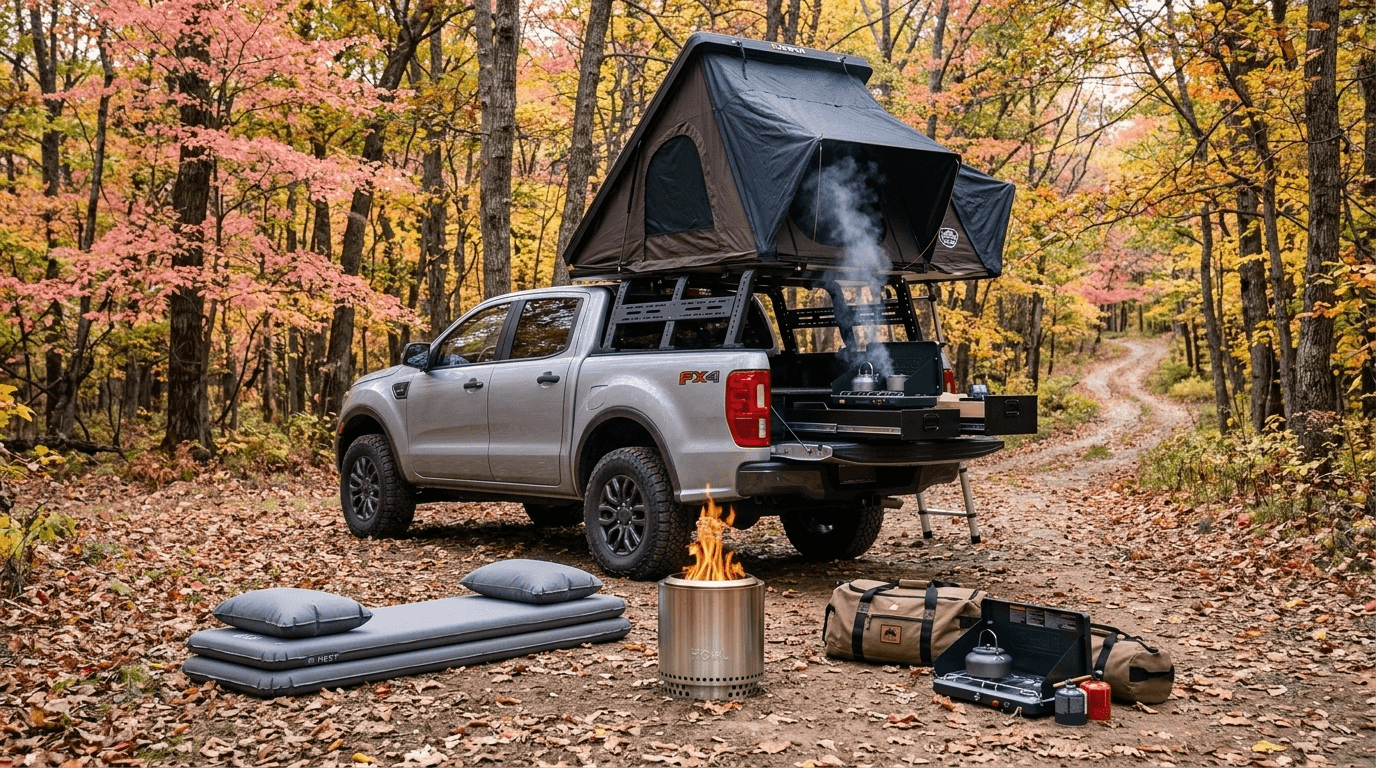
Howl Propane Fire Pit — Howl is a brand we’ve been genuinely excited about at OK4WD, and their portable propane fire pit is the product that started that excitement. It’s compact enough to travel in a loaded overland rig, sets up in minutes, and delivers real fire — flame, warmth, and atmosphere — without the logistics of sourcing firewood, the fire ban restrictions that apply to wood fires in many fall backcountry areas, or the Leave No Trace concerns of a ground fire. For fall overlanders who want a functional, reliable heat source at camp that works anywhere and any night regardless of conditions, the Howl propane fire pit is the most practical solution we’ve seen in this category. Propane fuel is widely available, the unit packs compactly, and the fire it produces is genuinely warm rather than the token flame of smaller tabletop units.
MC Ranch Overland Fire Reflector — Whether you’re running the Howl propane unit or a wood fire where permitted, an MC Ranch Overland fire reflector dramatically extends the warmth and utility of your camp fire setup. By directing heat outward from the fire toward the seating area, a fire reflector turns a fire that warms one side of you into one that genuinely heats the camp. On a 45°F fall evening, this is the difference between sitting close to the fire and actually being comfortable. MC Ranch Overland’s reflectors travel well and set up quickly — a straightforward addition to any fall camp kit.
MC Ranch Overland Firewood Carrier — For camps where wood fires are permitted and you want the real thing alongside or instead of the propane option, MC Ranch Overland’s firewood carrier keeps wood organized, off the ground, and accessible without the mess of loose firewood in your cargo area. A simple upgrade that keeps your kit organized and your firewood dry.
Sleep System — This Is Where Fall Overlanding Goes Wrong
The single most common fall overlanding mistake is underestimating sleep system requirements. A sleeping bag rated for 45°F is comfortable at 45°F — it is not comfortable at 38°F, which is what the temperature will be at 3am at 2,500 feet of elevation in the Catskills or Shenandoah in late October.
Rate your bag for 10–15°F below your expected overnight low. If overnight lows are forecast at 40°F, you want a bag rated for 25–30°F. This buffer accounts for elevation, unexpected weather, and the simple reality that bag temperature ratings are measured under controlled conditions that rarely match real-world camp sleeping.
Hest Sleep System — Hest makes premium overlanding sleep products — comforters, pillows, and sheet systems — designed specifically for vehicle-based travel and elevated camp comfort. Their down and synthetic fill products are engineered for the compact storage demands of an overland kit without the weight and bulk penalty of traditional camping bedding. For fall overlanders who want to sleep in genuine comfort rather than just survive the night, Hest’s comforter system paired with a quality sleeping bag creates a sleep setup that rivals what most people have at home. The Hest pillow in particular is one of those products that sounds like a luxury until you’ve used it — compact, packable, and dramatically more comfortable than an inflatable camp pillow. For shoulder season overlanding where you’re not pushing into extreme cold, Hest’s system can replace a dedicated sleeping bag entirely in a well-insulated rooftop tent or vehicle sleep setup.
Rooftop tent insulation — Fall is the season where a rooftop tent’s thermal properties matter. A quality RTT with an insulated liner holds heat significantly better than a ground tent and makes a meaningful difference in sleep comfort at overnight temperatures in the 40s. If your RTT has an available insulated liner, fall is the time to use it.
Layering — Dressing for Trail-to-Camp Temperature Swings
The 25–30°F temperature swing between a fall afternoon on the trail and a fall evening at camp demands a layering system — not a single jacket. Here’s the framework:
Base layer — Merino wool is the fall overlander’s best friend. It regulates temperature across a wide range, resists odor over multiple days of wear, and manages moisture from sweat and condensation better than synthetic alternatives. A midweight merino base layer handles most fall trail conditions comfortably.
Mid layer — A fleece or lightweight insulated jacket that can be added or removed as temperatures change through the day. This is the layer you’ll put on when you stop for lunch on the trail and take off when you’re moving again.
Outer layer — A wind and water-resistant shell that handles rain, wind, and morning condensation. Fall weather in the Mid-Atlantic and Northeast is variable — a quality shell is the layer that makes the kit weatherproof when conditions change.
Insulated layer for camp — A quality down or synthetic puffy jacket for camp use. This is the layer you add when you stop moving and the temperature starts dropping in the late afternoon. Packable puffy jackets compress small and add significant warmth — one of the best weight-to-warmth investments in a fall kit.
Hands, head, and feet — Heat loss from extremities is disproportionate to their size. A warm hat, gloves, and wool socks make a fall camp dramatically more comfortable. Pack them even if the forecast looks mild — fall weather changes fast in the backcountry.
Vehicle Prep for Fall Conditions
Fall overlanding in the Mid-Atlantic and Northeast introduces conditions your summer trail kit wasn’t designed for. A few vehicle-specific considerations:
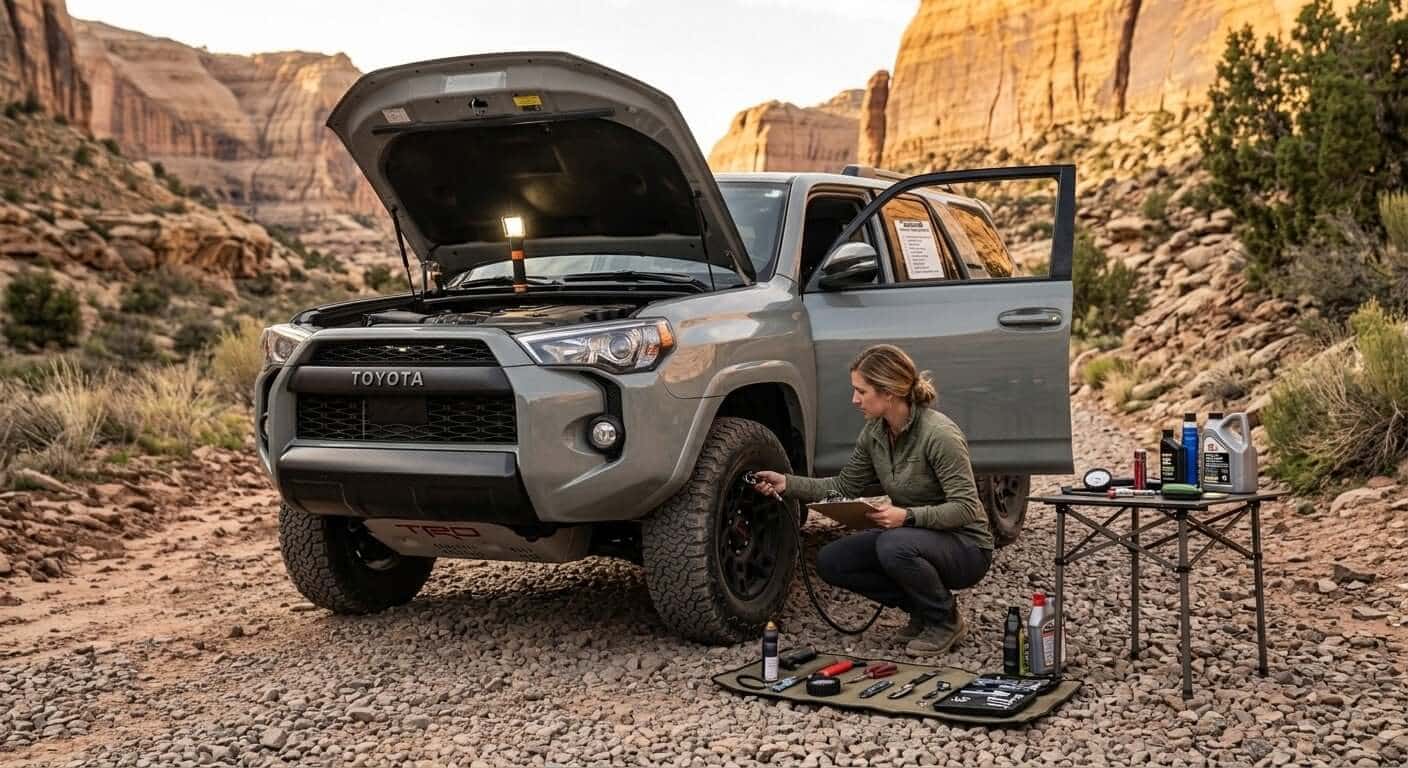
Tire pressure and cold weather — Tire pressure drops approximately 1 PSI for every 10°F drop in temperature. A tire aired to 30 PSI on a 70°F afternoon will read closer to 27–28 PSI on a 40°F morning. Check and adjust pressure in the morning before driving — both for trail performance and for accurate baseline readings when you air back up for the road.
Battery condition — Cold temperatures reduce battery capacity significantly. A battery that starts fine in summer can struggle at 35°F. Fall is the time to test your battery and replace it proactively if it’s marginal — not in January when it fails on the trail.
Fluids — Confirm your coolant is mixed appropriately for cold weather. Check your windshield washer fluid — standard summer formula freezes at 32°F. Switch to a winter formula rated for the temperatures you’ll encounter.
Condensation management — Fall overnight temperatures create significant condensation inside rooftop tents and vehicle interiors. Crack a vent slightly to allow moisture to escape — a sealed tent or vehicle interior accumulates condensation that makes your sleep system damp and cold by morning.
ICECO Portable Fridge in Cold Weather
One of fall overlanding’s unexpected advantages: your ICECO portable fridge works more efficiently in cooler ambient temperatures, consuming less power to maintain temperature. Fall is the season where a fridge-based food system really shines — food stays fresh longer, the unit runs more efficiently, and you’re not fighting 90°F ambient temperatures that challenge even quality portable refrigeration.
Camp Kitchen in Cold Weather
Fall cooking at camp is one of the genuine pleasures of shoulder season overlanding — cooler temperatures make standing over a Partner Steel stove significantly more enjoyable than a summer run. A few fall-specific considerations:
Hot beverages — Coffee and hot drinks become essential rather than optional in fall camp. A quality percolator or pour-over setup gets more use per trip in October than in July. Bring more coffee than you think you need — this advice doubles in the colder season.
One-pot meals — Cooler temperatures make hot, hearty one-pot meals — stews, chili, pasta — the natural camp food choice. These cook efficiently on a two-burner Partner Steel setup and deliver the warmth and calories that a fall day on the trail demands.
Kakadu Portable Shower in cold weather — A warm shower at camp becomes even more valued in cool temperatures. The Kakadu portable shower with warm water — heated on the Partner Steel stove if needed — is a comfort upgrade that earns its place in a fall kit more than any other season.
The Fall Overlanding Kit — What Changes from Summer
| Category | Summer | Fall Addition / Upgrade |
|---|---|---|
| Fire | Optional | Howl propane fire pit + MC Ranch reflector |
| Sleep | Summer-rated bag | 25–30°F bag or Hest comforter system |
| Clothing | Light layers | Merino base, insulated mid, shell, puffy |
| Extremities | Optional | Hat, gloves, wool socks — essential |
| Vehicle | Standard check | Battery test, coolant check, winter washer fluid |
| Cooking | Standard kit | Hot beverage setup, hearty one-pot meals |
| Tire pressure | Single check | Morning cold-weather check standard |
Bottom Line
Fall overlanding in the Mid-Atlantic and Northeast is some of the best overlanding the region offers — the conditions, the scenery, and the solitude are worth the additional gear investment. The Howl propane fire pit and MC Ranch Overland fire reflector solve the warmth-at-camp problem cleanly. The Hest sleep system elevates overnight comfort. Proper layering handles the temperature swings. And a few straightforward vehicle checks ensure your rig is ready for conditions it wasn’t running in all summer.
At OK4WD we carry Howl, MC Ranch Overland, Hest, ICECO, Partner Steel, Kakadu, and the full range of gear covered in this guide. Stop into our Stewartsville location or head to our website before your next fall run — we’ll help you put together the kit that makes shoulder season overlanding something you look forward to every year.
OK4WD has been equipping Jeeps and trucks for adventure since 1979. Browse our overland gear inventory or talk to our team about building your fall kit.
FAQs
What temperature is too cold for fall overlanding in a rooftop tent?
With the right sleep system and an insulated RTT liner, overnight temperatures into the mid-20s are manageable for experienced overlanders with appropriate gear. Below that, a heated vehicle sleep setup or a four-season tent is a more appropriate solution. For most fall overlanding in the Mid-Atlantic and Northeast, overnight lows in the 30s–40s are the realistic range — well within reach of a properly equipped RTT setup.
Are propane fire pits allowed where wood fires are banned?
In most cases, yes — campfire bans typically apply to open wood fires rather than contained propane units. Always confirm with the specific land management agency for your destination before assuming. The Howl propane fire pit’s contained design means it’s permitted in many areas where wood fires are restricted.
How do I keep my water from freezing overnight?
Store water containers inside your vehicle or RTT rather than in exposed exterior storage. Insulated containers slow the freezing process significantly. For temperatures approaching or below freezing, a small amount of stored heat inside the vehicle overnight is usually sufficient to keep water liquid.
Is fall overlanding appropriate for beginners?
Yes — with appropriate preparation. The gear demands are higher than summer but the trail conditions are often better — firmer surfaces, less dust, fewer people. A well-equipped beginner with appropriate cold weather gear has a better fall trail experience than an under-prepared experienced overlander.