Best Winches for Jeeps and Trucks — Buyer’s Guide
Winches are the most capable self-recovery tool available to an off-road driver. When a kinetic strap pull isn’t possible, traction boards aren’t enough, and the nearest help is miles away, a winch is what gets you out. Choosing the right one — the right capacity, the right build quality, and the right brand — matters more than most buyers realize until they’re in a situation where it needs to work.
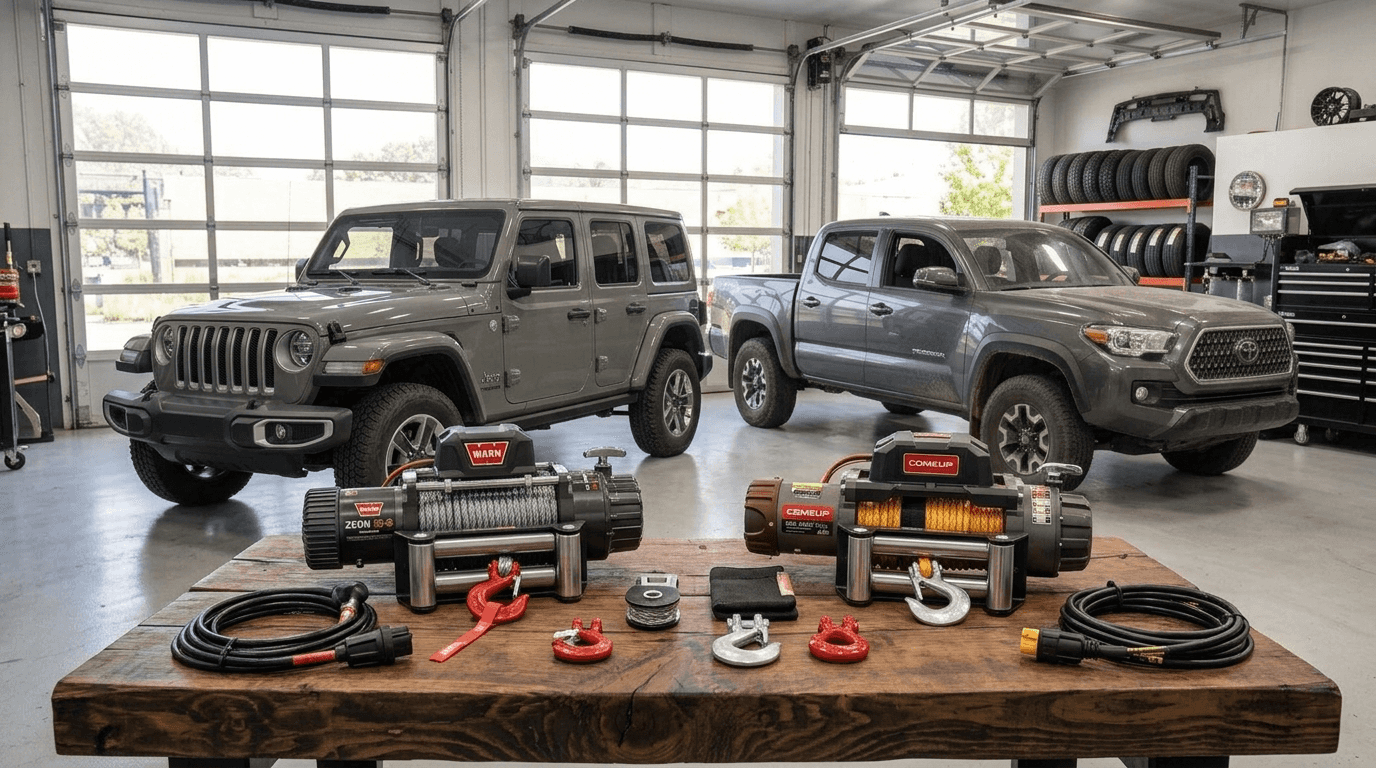
This guide breaks down the winch buying decision, what the specs actually mean, and the two brands we carry and recommend at OK4WD: Warn and Comeup.
Why a Winch Is Different from Every Other Recovery Tool
Every other recovery tool in your kit requires either another vehicle or favorable terrain — a strap needs a second vehicle to pull, traction boards need a surface to grip, a jack needs solid ground. A winch is the only self-recovery tool that works independently — anchored to a tree, a rock, a ground anchor, or another fixed point, it pulls your vehicle out of situations where nothing else can.
That independence is why a winch belongs on any serious off-road or overland build, and why the quality of that winch matters. The moment you need it is not the moment to discover it wasn’t built for the load.
What the Specs Actually Mean
Line Pull Rating
A winch’s line pull rating — expressed in pounds — is the maximum load it can pull on a single line wrap on the drum. This is the number most buyers focus on first, and it matters — but it requires context.
The 1.5x rule: The standard recommendation is a winch rated for at least 1.5 times your vehicle’s gross vehicle weight (GVW). For a 5,000 lb Jeep Wrangler, that’s a minimum 7,500 lb rated winch. For a fully loaded overland truck pushing 7,500–8,000 lbs, a 10,000–12,000 lb winch is the appropriate minimum.
Why line pull decreases with more wraps: A winch’s rated pull is measured on the outermost wrap of the drum. As line spools in and wraps stack up, the effective pull rating decreases — sometimes significantly. A 9,500 lb winch on a full drum may deliver only 6,000–7,000 lbs of actual pull. This is why buying more winch than you think you need is always the right call.
Doubling with a snatch block: Running your winch line through a snatch block and back to the vehicle effectively doubles the pulling power while halving the line speed. For heavy recovery situations, a quality snatch block is as important as the winch itself.
Motor Type
Series wound motors — The traditional winch motor type. Series wound motors deliver high torque and perform well under sustained heavy loads. They draw more power from your electrical system and generate more heat than permanent magnet motors. The preferred choice for serious off-road use where heavy, sustained pulls are common.
Permanent magnet motors — More efficient and less taxing on your electrical system for moderate pulls. Performance drops more significantly under sustained heavy load and in extreme cold compared to series wound motors. More common in lighter-duty and mid-range winches.
Synthetic vs. Steel Cable
Steel cable is more abrasion-resistant and less expensive. It handles contact with rocks and rough surfaces without the wear concerns of synthetic rope. The significant downside: when steel cable fails under load it stores and releases tremendous energy — the resulting whip is a serious safety hazard. Steel cable also kinks, rusts, and is hard on hands.
Synthetic rope is lighter, safer when it fails (it drops rather than whips), easier on hands, and floats in water crossings. It’s become the standard on serious off-road builds for safety reasons alone. The tradeoff is susceptibility to abrasion on rocky terrain — keep it off the ground and inspect it regularly.
Gear Train
Three-stage planetary gear trains are the standard in quality winches — they deliver the gear reduction needed for high torque output in a compact package. Look for hardened steel gears in the gear train — softer materials show wear quickly under sustained use.
IP Rating
An IP (Ingress Protection) rating tells you how well the winch is sealed against water and dust intrusion. For off-road use — water crossings, mud, rain — look for a minimum IP67 rating, which indicates full dust protection and resistance to water immersion up to one meter. Higher ratings are better.
The Brands We Carry
Warn
Warn is the most recognized name in off-road winches — and the recognition is earned. Founded in 1948, Warn has been building winches longer than most of their competitors have existed. Their product lineup spans from entry-level utility winches to purpose-built competition rock crawling systems, and their engineering at every tier reflects decades of refinement.
Warn Zeon Series — Warn’s flagship consumer off-road winch line and one of the most capable production winches available. The Zeon 10-S and Zeon 12-S (10,000 and 12,000 lb ratings respectively) are built around a series wound motor, a three-stage planetary gear train with hardened steel gears, and a waterproof IP67 rating. Synthetic rope is standard on S-model Zeons — the aluminum hawse fairlead is included. For Jeep and truck builds where uncompromising reliability and recovery capability is the priority, the Zeon is the conversation to start with.
Warn VR EVO Series — Warn’s mid-range off-road winch lineup, available in 8,000, 10,000, and 12,000 lb ratings. The VR EVO uses a series wound motor and three-stage planetary gearing — the same core architecture as the Zeon at a more accessible price point. Available in both steel and synthetic rope configurations. The VR EVO 10-S delivers genuine Warn reliability and a series wound motor at a mid-range price that makes a quality winch accessible without cutting corners on the components that matter.
Warn ZEON Platinum — Warn’s premium tier. Integrated contactor and control box, wireless remote capability, and refined engineering throughout. For builds where a clean, integrated install and wireless control are priorities alongside maximum recovery capability, the Zeon Platinum is the top of the Warn lineup.
Why Warn: Three reasons. First, series wound motors across their performance lineup — the right architecture for serious recovery use. Second, decades of real-world track record across every terrain type and climate. Third, parts availability and service support — if something goes wrong with a Warn winch, parts exist and support is available. That matters when you’re building a rig to last.
Comeup
Comeup is a Taiwanese manufacturer with a following in the off-road community that’s larger than their brand recognition might suggest. Their winches are built to a high standard, competitively priced relative to comparable Warn models, and have developed a strong reputation for reliability in real-world use.
Comeup Seal Gen2 Series — Comeup’s flagship sealed winch lineup and their strongest offering for serious off-road use. Available in 9,500 and 12,000 lb ratings, the Seal Gen2 features an IP68 waterproof rating — better than the industry standard IP67 and a meaningful advantage in deep water crossings and sustained wet conditions. Series wound motor, three-stage planetary gearing with hardened steel gears, and available in synthetic rope configurations. The IP68 rating is a genuine differentiator — for builds that regularly encounter deep water or extended wet conditions, the Seal Gen2’s sealing is a real advantage.
Comeup Cub 6.0s — Comeup’s mid-range offering at 6,000 lb rating. A strong choice for lighter vehicles — shorter Jeeps, lighter trucks, or builds where payload capacity means the vehicle rarely approaches its GVW on the trail. Permanent magnet motor at this tier — appropriate for the load range.
Comeup DV-9i — A well-regarded 9,000 lb series wound winch that sits between the Cub and the Seal Gen2 in the lineup. A solid mid-range option for builds where the Seal Gen2’s IP68 rating isn’t a priority but series wound motor performance is.
Why Comeup: Comeup delivers genuine series wound motor performance and quality planetary gearing at a price point that makes a capable winch more accessible. The Seal Gen2’s IP68 rating is a spec advantage over comparable Warn models. For buyers who want a reliable, capable winch with strong real-world credentials and a more accessible price point than the Warn Zeon, Comeup is the right conversation.
Warn vs. Comeup — How to Choose
| Warn VR EVO | Warn Zeon | Comeup Seal Gen2 | |
|---|---|---|---|
| Line Pull | 8k–12k lbs | 10k–12k lbs | 9.5k–12k lbs |
| Motor | Series wound | Series wound | Series wound |
| IP Rating | IP68 | IP67 | IP68 |
| Rope | Steel or synthetic | Synthetic standard | Steel or synthetic |
| Price Tier | Mid-range | Premium | Mid-range |
| Best For | Reliable daily trail use | Maximum capability and longevity | Deep water builds, value-focused buyers |
The honest take: both brands deliver capable, reliable winches that will perform when you need them. Warn’s advantage is brand track record, parts availability, and the Zeon’s refined engineering at the premium tier. Comeup’s advantage is the Seal Gen2’s IP68 rating and competitive pricing for series wound motor performance. For most buyers, the Warn VR EVO and the Comeup Seal Gen2 are the comparison that matters — both deliver series wound reliability in the mid-range price tier where most purchasing decisions live.
Installation Considerations
A winch install is more than bolting a unit to a bumper mount. A few things to get right:
Electrical system — A winch draws significant amperage under load — a 10,000 lb winch can draw 400+ amps at maximum pull. Your battery, alternator, and wiring need to be up to the task. A dedicated winch battery or dual battery system is worth considering for serious use. At minimum, confirm your existing electrical system can handle the load before installing.
Bumper compatibility — Confirm your bumper’s winch mount is rated for the winch you’re installing and that the mounting pattern matches. Most quality off-road bumpers — including ARB’s lineup — are designed around standard winch mounting patterns.
Synthetic rope and fairlead — If you’re running synthetic rope, you need an aluminum hawse fairlead — not a roller fairlead designed for steel cable. Installing synthetic rope through a roller fairlead damages the rope over time.
Wireless remote — A wireless remote is a meaningful safety upgrade over a corded controller — it lets you operate the winch from a safe position away from the cable under tension. Available as an accessory on most Warn and Comeup models.
Bottom Line
A winch is a long-term investment in self-sufficiency — buy it once and buy it right. Warn’s VR EVO delivers proven series wound reliability at a mid-range price point. The Zeon is the top-tier choice for maximum capability and longevity. Comeup’s Seal Gen2 brings IP68 sealing and series wound performance at a competitive price for buyers who prioritize value and wet-condition performance.
At OK4WD we carry and install both Warn and Comeup across a broad range of vehicles. Stop into our Stewartsville location or give us a call — we’ll match you to the right winch for your rig, your use case, and your budget.
OK4WD has been equipping Jeeps and trucks since 1979. Browse our winch inventory or schedule an installation with our service team.
FAQs
What size winch do I need for a Jeep Wrangler?
For a stock or mildly built Wrangler, a 9,500–10,000 lb winch meets the 1.5x GVW rule comfortably. For a heavily built Wrangler with significant added weight — steel bumpers, full skid plate package, overland kit — a 12,000 lb winch is the better call.
What size winch do I need for a full-size truck?
Full-size trucks — F-150, Ram 1500, Tacoma in the heavier configurations — typically require a 12,000 lb winch at minimum when applying the 1.5x rule to a loaded vehicle. Super Duty and heavy-duty truck owners should look at 16,500 lb and above.
Is synthetic rope worth the extra cost over steel cable?
Yes — for the vast majority of off-road use. The safety advantage of synthetic rope that drops rather than whips on failure is significant. The weight savings and ease of handling are meaningful bonuses.
Can I install a winch myself?
The mechanical mounting is DIY-friendly for someone with basic mechanical skills. The electrical work — running a dedicated power feed from the battery, correct fusing, and proper connection — benefits from professional installation to ensure it’s done correctly and safely.