Tire Pressure: Air Up, Air Down, Air What?
Air up, air down, air what? One of the most widespread pieces of advice given to any off-road novice is to always air down, or that airing down and a shovel can get you out of just as many crises as any fancy gear. But what is "airing down," and why is it such sage advice within the community?
What Is It?
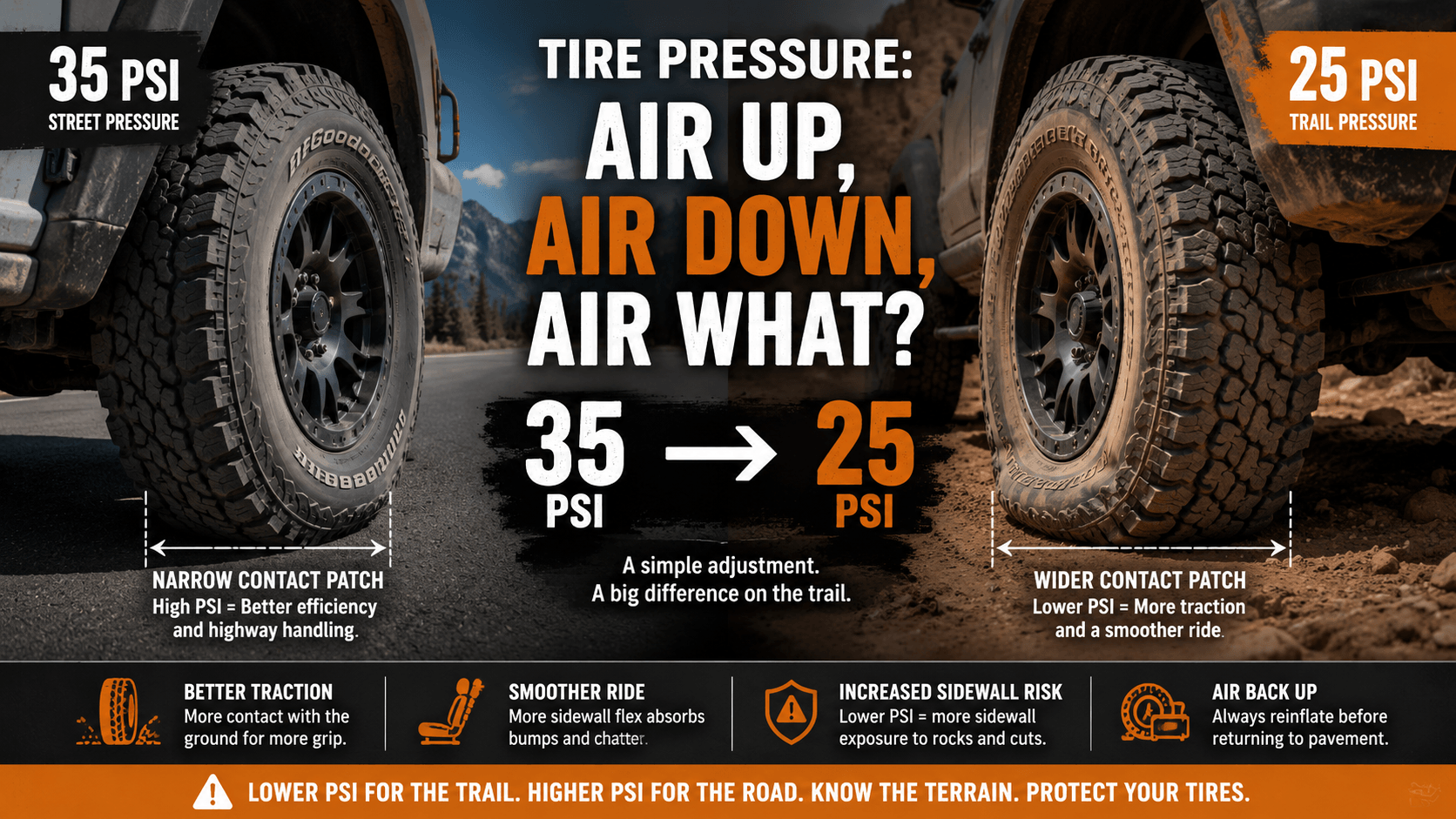
The definition of airing down is lowering the tire pressure (or PSI) by removing air from inside the tires. Most trucks and SUVs run between 32 and 36 PSI on pavement — to air down for off-road use typically means dropping into the low-to-mid 20s, giving the tire a fundamentally different character on the trail. The reasoning behind this practice is that more deflated tires have a wider strip or greater surface area connecting them with the ground, increasing traction. Just as snowshoes are wider to allow for both more grip and a lower likelihood of getting stuck, the same principle applies to your tires. However, the drawbacks remain the same: just like if you ever tried running in snowshoes, it's significantly slower, more ungainly, and expends a lot more energy than a slim sneaker.
Also worth noting is that the recommended PSI for most trucks is calculated assuming a load — a significant amount of weight in the bed. That means an unladen truck's ideal off-road PSI may actually be lower than what's printed on the door jamb sticker, giving you a bit more room to work with.
Lower air pressure also allows for a smoother ride. The softer tires absorb more unevenness from the terrain, making small disturbances less likely to jolt either you or your passengers. The absorption comes from the increased flex, which also has the upside of reducing punctures to or between the tread. However, a lower PSI causes the sidewall to bulge outward — like pressing your thumb into a balloon — making it more vulnerable to slicing on sharp rocks or obstacles. The careful, slow driving that naturally comes with lower pressure should offset this risk, but it's worth keeping in mind.
How Do I Do It?
The easiest way to check your current PSI is through your vehicle's dashboard display, though it can be unintuitive to navigate or simply absent on older rigs. In those cases, a handheld gauge pressed to the valve stem on each tire will do the job just as well.
To deflate, press down on the valve stem core — either by hand, with a small tool, or with a dedicated deflator valve like the Air Deflator Valve Style With Gauge, which lets you release air in a controlled and measurable way without the guesswork. Go slowly and check your gauge frequently. It's far easier to monitor as you go than to overshoot your target PSI and have to re-inflate on the spot.
For off-roading, a target of around 25 PSI is a reasonable starting point for most trucks on mixed terrain. Increase slightly for rocky, technical ground where rim protection matters more; go lower for deep mud or sand where maximum contact patch is the priority. One important limit to keep in mind: going too low risks unseating the tire bead from the rim entirely, which can leave you stranded far from help. If you're unsure of your floor, consult your tire manufacturer's specs or ask at your local shop.
Continue monitoring your pressure throughout your ride. Catching a slow leak early is far better than discovering it when the tire is nearly flat.
The Catch
Despite all of the benefits of airing down, underinflation comes with real risks that are easy to overlook in the excitement of the trail. Underinflated tires wear out quickly due to increased friction from the larger contact patch, and they offer less protection for your rims against hard impacts.
Most importantly: always air back up before returning to pavement. Higher speeds, increased braking, and sustained highway driving generate heat that deflated tires are not built to handle. A portable 12V air compressor — like the ARB Portable 12v Air Compressor — makes this process fast and straightforward, and is an essential companion to any deflator in your kit. The key is learning to balance the grip gained from lower pressure against the protection lost from it. The best way to develop that feel is through experience, though that isn't to say you shouldn't seek out advice from your local groups or more experienced friends.
Final Thought
Tire pressure is one of the lowest-cost, highest-impact adjustments you can make on the trail. Master the basics, invest in a quality deflator and compressor, and it quickly becomes second nature — one less thing to worry about when the terrain gets interesting.