OK4WD Builds and Articles
- What Is Wheel Offset?
- What Is Wheel Backspacing?
- Offset vs. Backspacing: Key Differences at a Glance
- How to Convert Between Offset and Backspacing
- Real-World Examples
- Why Offset and Backspacing Matter Beyond Looks
- Lift Kit Manufacturer Specifications
- Frequently Asked Questions
- What is the difference between positive and negative offset?
- Can I fit any size wheel on my vehicle?
- What happens if I use the wrong offset?
- How do I measure my wheel's backspacing?
- What is ET offset?
- Does offset affect tire rubbing?
- Can I run negative offset with a stock suspension?
- What is the stock offset on a Jeep Wrangler?
- Let Our Team Figure It Out for You

As professional tire and wheel installers, one of the most popular questions we deal with every day is: "What wheels and tires can I fit on my vehicle?" The answer varies case by case, but the fundamentals apply to every car or truck. Wheels are classified by diameter, width, load rating, and finish — but two of the most important specs when choosing custom wheels are backspacing and wheel offset.
Many people believe offset and backspacing are the same thing. They're related — but each has its own definition and affects your vehicle's stance differently. Here's exactly how they work, how to convert between them, and why getting both right matters for more than just looks.
What Is Wheel Offset?
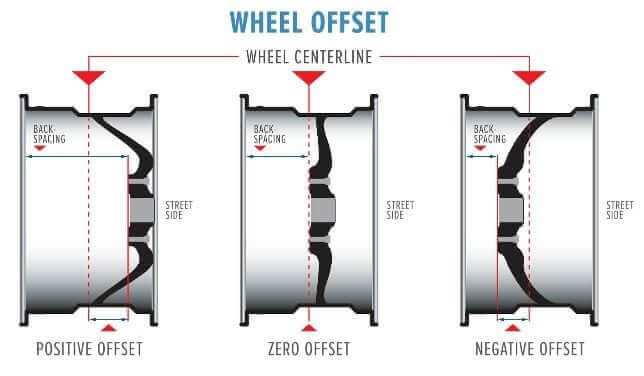
Offset is the distance — measured in millimeters — from the mounting surface of the wheel to the centerline of the wheel.
Positive vs. Negative Offset Explained
Offset can be positive, negative, or zero:
- Positive offset: The mounting surface sits toward the outer (street-facing) face of the wheel. This pushes the wheel inward, tucking it under the fender. Most modern passenger cars and trucks run positive offset from the factory.
- Negative offset: The mounting surface sits toward the inner face of the wheel. This pushes the wheel outward, creating a wider, more aggressive stance.
- Zero offset: The mounting surface sits exactly at the centerline.
To visualize this: think of a bicycle wheel. Positive offset is like pushing the hub toward the outer rim. Negative offset is like shifting the hub back toward the bike's frame.
Quick tip: Offset is commonly marked on wheels as "ET" — from the German Einpresstiefe, meaning "insertion depth." ET+44 means +44 mm positive offset. Same measurement, different notation — used widely by OEMs and European wheel manufacturers.
What Is Wheel Backspacing?
Backspacing is the distance — measured in inches — from the mounting surface of the wheel to the inner edge (back lip) of the wheel.
Think of it as how far the mounting surface is recessed from the back of the wheel. A higher backspacing number means the wheel sits deeper into the wheel well, closer to the suspension and frame. Lower backspacing pushes the wheel outward. Unlike offset, backspacing is always a positive number.
How to measure it: Lay the wheel face-down on a flat surface. Place a straightedge across the back of the wheel. Measure the distance from the straightedge down to the mounting pad (hub surface). That is your backspacing.
Offset vs. Backspacing: Key Differences at a Glance
| Wheel Offset | Wheel Backspacing | |
|---|---|---|
| Unit | Millimeters (mm) | Inches (in) |
| Measured from | Wheel centerline | Inner edge (back lip) of wheel |
| Can be | Positive, negative, or zero | Positive only |
| Common in | OEM specs, European wheels | Aftermarket, US truck & 4WD market |
| Primary effect | Lateral wheel position | Depth into the wheel well |
How to Convert Between Offset and Backspacing
These two measurements describe the same physical reality from different reference points. You can convert between them with this formula:
Offset (mm) = [Backspacing (in) × 25.4] − [(Wheel Width (in) + 1) × 12.7]
Worked example — Stock 2011 Ford F-250 (18×8, 6.07 in backspacing):
- Convert backspacing to mm: 6.07 × 25.4 = 154.2 mm
- Calculate half of (wheel width + 1) in mm: (8 + 1) × 12.7 = 114.3 mm
- Offset = 154.2 − 114.3 = +39.9 mm (≈ +40 mm)
This matches Ford's published stock offset spec for the F-250, confirming the formula. Use it any time a wheel manufacturer lists one spec but not the other.
Real-World Examples
2011 Ford F-250 — Stock vs. Aftermarket Wheels
The stock 18×8 wheels on a 2011 Ford F-250 have 6.07 inches of backspacing. This keeps the wheel and tire inside the fender at stock ride height with stock-size tires.
Moving to an 18×9 Fuel Hostage wheel opens up several backspacing options: 5.75 in, 5.0 in, or 4.5 in. All three could work on the same truck — but the right choice depends on lift height, tire size, and vehicle-specific variables like brake caliper clearance and fender liner position. This is the kind of fitment decision our team works through with customers every day.
Jeep Wrangler JL — Why Offset Changes with a Lift
The stock Jeep Wrangler JL runs 17×7.5 wheels at approximately +44 mm offset (roughly 5.9 inches of backspacing). At stock height, this tucks the wheel neatly under the fender.
Add a 2.5-inch lift and 35-inch tires, and that math changes completely. Most JL owners running 35s target a backspacing of 4.5–4.75 inches (roughly +18 mm to +25 mm offset):
- Too deep (high backspacing / too positive): The inner barrel can contact the upper control arm, coilover body, or inner fender liner under compression or full steering lock.
- Too shallow (low backspacing / too negative): The tire catches the outer fender lip, accelerates wheel bearing wear, and can reduce steering travel.
Wheel spacers can help fine-tune fitment, but they are not a substitute for selecting the correct offset in the first place.
Why Offset and Backspacing Matter Beyond Looks
Stance is the obvious effect — but offset and backspacing have real mechanical consequences:
- Suspension clearance: Too much positive offset (deep backspacing) can cause the inner wheel barrel to contact the upper control arm, coilover, or brake caliper.
- Fender rubbing: Too much negative offset pushes the tire outward — into the fender lip — especially at full steering lock or full suspension compression.
- Wheel bearing load: Excessive negative offset increases the lever arm on the wheel bearing, accelerating wear and shortening its service life.
- Turning radius: Incorrect fitment can physically restrict how far the wheel turns before contacting something.
- Wheel travel: On lifted trucks, suspension travel increases. A wheel that clears at rest can rub at full droop or full compression. This must be checked through the full range of motion.
Lift Kit Manufacturer Specifications
Most lift kit manufacturers — Rough Country, BDS Suspension, Fox, Icon, ReadyLIFT, and others — publish specific offset and backspacing windows for their kits. These are not suggestions. They are the result of engineering testing with specific wheel and tire combinations.
When a manufacturer specifies "minimum 4.5 inches backspacing" for a 4-inch lift, going outside that window can cause contact, handling problems, or void the kit warranty. Our team at OK4WD references these specs daily — we'll tell you exactly which combination works for your lift, tire size, and vehicle before anything goes on a truck.
Frequently Asked Questions
What is the difference between positive and negative offset?
Positive offset means the mounting surface is toward the outer (street-facing) face of the wheel, pushing the wheel inward under the fender. Negative offset means the mounting surface is toward the inner face, pushing the wheel outward for a wider, more aggressive stance.
Can I fit any size wheel on my vehicle?
No. Fitment depends on wheel well clearance, suspension geometry, brake caliper dimensions, and — if the vehicle is lifted — your lift kit manufacturer's specifications. Our team at OK4WD confirms fitment before purchase, so there are no surprises at installation.
What happens if I use the wrong offset?
Too much positive offset can cause the wheel barrel to contact suspension components or brake hardware. Too much negative offset can cause tire-to-fender rubbing, stress wheel bearings, and reduce steering lock. Both create safety and premature wear issues beyond just appearance.
How do I measure my wheel's backspacing?
Lay the wheel face-down on a flat surface. Place a straightedge across the back of the wheel. Measure the distance from the straightedge down to the mounting pad (hub surface). That measurement — in inches — is your backspacing.
What is ET offset?
"ET" is from the German Einpresstiefe ("insertion depth") and is the standard European notation for wheel offset in millimeters. ET+44 is the same as +44 mm positive offset. You'll see ET labeling on most OEM wheels and European aftermarket brands.
Does offset affect tire rubbing?
Yes, directly. Moving toward negative offset pushes the tire outward — toward the fender lip. Moving toward positive offset pushes it inward — toward the suspension. Outer fender rubbing means you need more positive offset or less aggressive backspacing. Inner liner or control arm contact means the opposite.
Can I run negative offset with a stock suspension?
On most trucks and SUVs, mild negative offset is manageable at stock height — but it depends on wheel well dimensions and tire size. On lifted vehicles, increased clearance makes more aggressive negative offsets viable. Always cross-reference against your vehicle's factory specs or your lift kit's fitment guide before ordering.
What is the stock offset on a Jeep Wrangler?
Stock JL Wrangler wheels run approximately +44 mm offset on 17×7.5 wheels with roughly 5.9 inches of backspacing. JK Wranglers are similar. Most serious JL/JK builds running 35-inch tires target +18 mm to +25 mm offset, depending on lift height and tire diameter.
Let Our Team Figure It Out for You
Offset and backspacing can make or break the look of your vehicle — but more importantly, they determine whether your wheels and tires work safely with your suspension through every inch of travel. Getting it right the first time saves money, headaches, and callbacks.
Our team at OK4WD has been fitting wheels and tires on Jeeps, trucks, and 4WD vehicles since 1979. Tell us your vehicle, your lift, and your tire size — we'll nail the offset and backspacing spec for your exact application.