How Much Does It Cost to Lift a Truck or Jeep? (Honest Breakdown)
If you've been eyeing a lift kit and wondering what it's actually going to cost you, the honest answer is: it depends — but we can break it down in a way that makes sense before you spend a dime. This guide covers lift types, what drives the cost, and links out to our dedicated guides for every major platform we build on.
Find Your Platform
Every truck and Jeep has its own lift story — different suspension architecture, different geometry considerations, and different brands that excel on that specific platform. If you already know what you're driving, jump straight to your vehicle guide:
- Best Lift Kits for Jeep Wrangler JK & JL — Buyer's Guide
- Best Lift Kits for Toyota Tacoma — Buyer's Guide (2nd, 3rd & 4th Gen)
- Best Lift Kits for Ford F-150 — Buyer's Guide (12th, 13th & 14th Gen)
- Best Lift Kits for Ram 1500 — Buyer's Guide (3rd & 4th Gen)
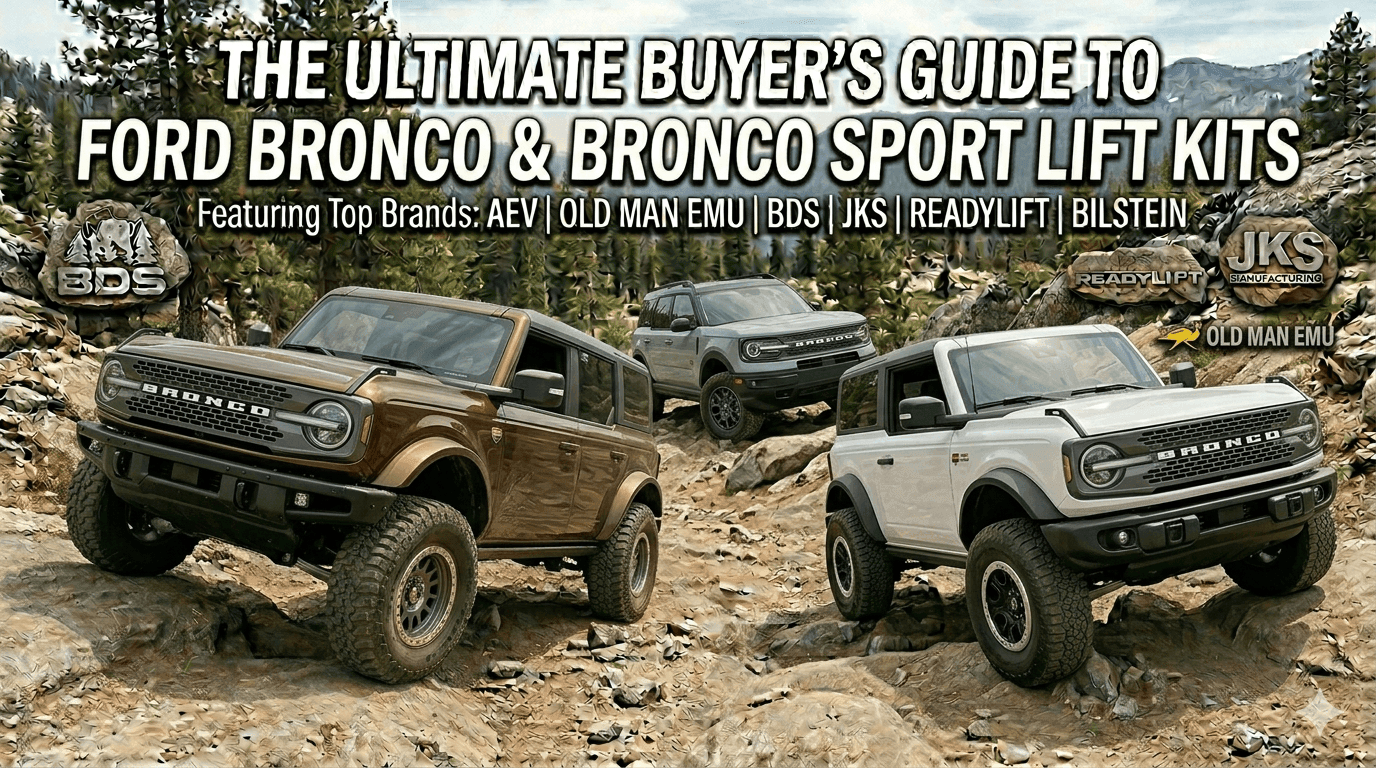
- Best Lift Kits for Ford Bronco & Bronco Sport — Buyer's Guide
Not sure where to start? Keep reading — we'll walk you through everything you need to know before making a decision.
What Are You Actually Paying For?
A lift job has two cost buckets: parts and labor. Both vary significantly based on your vehicle, how much lift you want, and the quality of components you choose. Here's how to think about each.
Lift Types and What They Cost
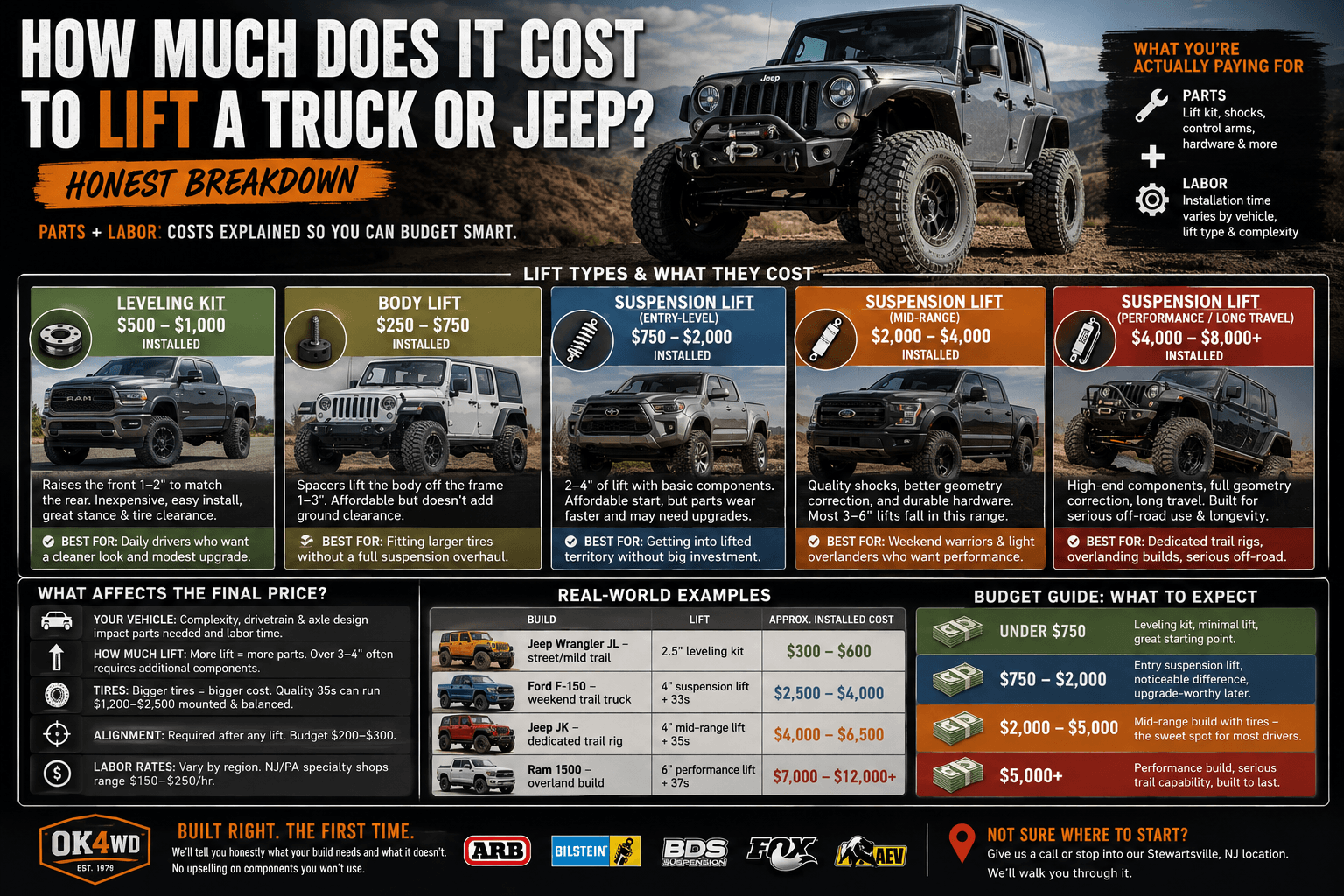
Leveling Kit — $500 to $1000 installed
This is the entry point. A leveling kit raises the front of your truck 1–2 inches to match the rear, giving you a more aggressive stance and room for slightly larger tires. Parts are inexpensive and installs are straightforward — most shops can knock it out in an hour or two.
Best for: Daily drivers who want a cleaner look and a modest tire upgrade.
Body Lift — $250 to $750 installed
Body lifts use spacers to raise the body off the frame — typically 1 to 3 inches. They're affordable but don't improve ground clearance under the axles. Less popular than they used to be, but still a practical option for fitting larger tires without a full suspension overhaul.
Best for: Fitting larger tires without a full suspension overhaul.
Suspension Lift (Entry-Level) — $750 to $2,000 installed
Entry-level suspension lifts get you 2–4 inches of lift with basic components. It's an accessible starting point, but components tend to wear faster and many customers find themselves upgrading within a few years.
Best for: Getting into lifted territory without a large upfront investment.
Suspension Lift (Mid-Range) — $2,000 to $4,000 installed
This is where most serious builds land. Mid-range kits from brands like ReadyLift and BDS give you quality shocks, better geometry correction, and hardware that holds up on the trail. Most lifts in the 3–6 inch range fall here depending on the vehicle.
Best for: Weekend warriors and light overlanders who want performance without going full custom.
Suspension Lift (Performance/Long Travel) — $4,000 to $8,000+ installed
High-end lifts from FOX, ARB (Old Man Emu), AEV, and Bilstein paired with full geometry correction kits, new control arms, and upgraded hardware. These setups are built for serious off-road use and longevity. Labor costs climb here too — installation on a complex kit can run 8–12 shop hours.
Best for: Dedicated trail rigs, overlanding builds, and anyone who spends significant time off pavement.
The Brands We Trust
Not all lift kits are created equal. At OK4WD we've been installing suspension systems since 1979 and we've seen what holds up and what doesn't. Here are the brands we carry and recommend across our vehicle lineup:
ARB / Old Man Emu — One of the most globally trusted names in off-road suspension. OME systems prioritize a balanced, controlled ride with long-term durability. ARB's broader ecosystem of recovery gear, air compressors, and protection products makes them a natural fit for complete overland builds.
AEV (American Expedition Vehicles) — The gold standard for Jeep-specific builds. AEV engineers exclusively for Jeep platforms and their DualSport suspension systems are built for owners who want factory-quality engineering in an aftermarket kit.
BDS Suspension — Decades of lift kit experience across nearly every platform we build on. BDS kits are thoroughly engineered, include quality geometry correction hardware, and are backed by a no-fine-print lifetime warranty.
Bilstein — German-engineered monotube shock technology trusted by OEM manufacturers and aftermarket builders alike. Bilstein's 5100 and B8 series are among the most cost-effective performance upgrades available on any platform.
FOX — The performance shock standard. FOX's remote reservoir and internal bypass systems are spec'd by factory performance trucks and trusted by serious off-road builders worldwide. When you want the best damping available, FOX is the conversation.
ReadyLIFT — Our go-to for clean, reliable leveling and entry lift solutions. ReadyLIFT's SST systems deliver proven performance at an accessible price point and cover a broad range of platforms including air suspension-equipped trucks.
What Affects the Final Price?
Your vehicle. A Jeep Wrangler JL is one of the most straightforward lifts on the market — parts are abundant and techs know them cold. A Super Duty or full-size truck with independent front suspension takes more time and specialized hardware. Your vehicle complexity will also help determine DIY vs. professional installation.
Drivetrain and axle configuration. Solid axle vehicles like the Wrangler or older Tacomas are generally simpler and less expensive to lift than trucks with independent front suspension (IFS). IFS vehicles require more precise geometry correction and often need upper control arm upgrades to maintain proper alignment and CV axle angles after a lift. That adds both parts and labor to the final bill.
How much lift you want. Anything over 3–4 inches often requires additional components — control arms, extended brake lines, track bars, and alignment corrections — that add cost beyond the kit itself.
Tires. Most people lift to run bigger tires, and tires are often the biggest line item. A set of quality 35s can run $1,200–$2,500 mounted and balanced. Factor this in from the start.
Alignment. Any lift requires a professional alignment after install. Budget $200–$300 for this — skipping it will wear your tires unevenly and compromise handling.
Labor rates. Shop rates vary by region. In the NJ/PA area, expect $150–$250/hr at a specialty shop. A basic leveling kit might take 1.5 hours while a full suspension kit with add-ons can take a full day or more at a professional shop.
DIY vs. Professional Install
Some leveling kits are DIY-friendly if you have a lift, basic tools, and mechanical confidence. But for anything involving suspension geometry, extended brake lines, or alignment — professional installation is worth every dollar.
Here's what can go wrong on an improperly installed lift: caster angle gets thrown off, causing the vehicle to pull and accelerating tire wear; brake lines get routed without enough slack, creating a failure risk on full droop; CV axle angles exceed their operating range, leading to vibration and premature joint failure. None of these are obvious at first — they show up miles down the road, literally and figuratively.
At OK4WD, our install team has been doing this since 1979. We'll tell you honestly what your build needs and what it doesn't — no upselling on components you won't use.
Real-World Examples
| Build | Lift | Approximate Installed Cost |
|---|---|---|
| Jeep Wrangler JL — street/mild trail | 2.5" leveling kit | $300–$600 |
| Ford F-150 — weekend trail truck | 4" suspension lift + 33s | $2,500–$4,000 |
| Jeep JK — dedicated trail rig | 4" mid-range lift + 35s | $4,000–$6,500 |
| Ram 1500 — overland build | 6" performance lift + 37s | $7,000–$12,000+ |
Bottom Line
| Budget | What to Expect |
|---|---|
| Under $750 | Leveling kit, minimal lift, great starting point |
| $750–$2,000 | Entry suspension lift, noticeable difference, upgrade-worthy later |
| $2,000–$5,000 | Mid-range build with tires — the sweet spot for most drivers |
| $5,000+ | Performance build, serious trail capability, built to last |
The best lift is the one that matches how you actually use your vehicle. At OK4WD we stock the brands that hold up — ARB, Bilstein, BDS, FOX, AEV — because we'd rather set your build up right the first time. If you're not sure where to start, give us a call or stop into our Stewartsville location — we'll walk you through it.
OK4WD has been building Jeeps and trucks in New Jersey since 1979. Browse our lift kit inventory or schedule a consultation with our service team.
FAQs
Do I need new shocks with a lift kit?
In most cases, yes. A lift changes your suspension geometry and travel range — running stock shocks with a lifted suspension leads to poor ride quality and faster wear. Quality kits from brands like Bilstein, FOX, and Rancho include matched shocks for this reason.
Does lifting a truck hurt resale value?
A quality lift from reputable brands, professionally installed, generally has a neutral to positive effect on resale in the off-road market. A cheap or poorly installed lift is a different story — buyers notice, and it can raise red flags about how the vehicle was treated overall.
How long does a lift install take?
A leveling kit typically takes 1.5–2 hours. A full suspension lift with geometry corrections and a tire swap can take a full day or more. Plan accordingly and ask your shop for a time estimate upfront.
Can I lift any truck or Jeep?
Almost any vehicle can be lifted to some degree, but the right approach varies significantly by make, model, and year. Some platforms have more aftermarket support than others. When in doubt, talk to a specialist before buying — fitment matters.