If you're new to off-roading or overlanding, you've probably heard people talk about gear ratios when discussing their vehicle build, axle upgrades, or larger tires.
For many beginners, gear ratios sound complicated. But once you understand the basic idea, it becomes much easier to see why they matter for off-road performance.
In this guide, we'll explain what gear ratios are, how they affect your 4WD vehicle, and why they become important when modifying your rig.
What Is a Gear Ratio?
A gear ratio describes how many times your driveshaft rotates compared to how many times your wheels rotate.
For example:
A 4.10:1 gear ratio means the driveshaft spins 4.10 times for every one rotation of the wheels.
This gearing multiplies the power coming from the engine before it reaches the tires.
Think of it as a way of trading speed for torque (pulling power).
Simple Diagram: How a Gear Ratio Works
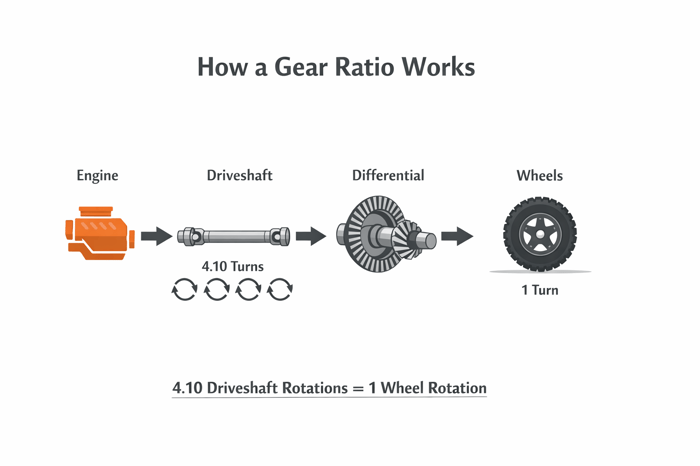
In this example, the driveshaft turns about four times before the wheels complete one full rotation.
More rotations at the driveshaft means more torque delivered to the wheels.
High vs. Low Gear Ratios
When people talk about gear ratios, they usually refer to the numerical value of the ratio.
Higher Numerical Ratios
Examples: 4.56, 4.88, 5.13
These ratios:
• Deliver more torque to the wheels
• Improve low-speed control
• Make it easier to turn larger tires
• Work well for off-road driving
The tradeoff is that the engine may run at higher RPM on the highway, which can reduce fuel economy.
Lower Numerical Ratios
Examples: 3.21, 3.55, 3.73
These ratios:
• Allow the vehicle to cruise at lower RPM
• Improve highway fuel efficiency
• Are common in factory vehicles designed for daily driving
However, they deliver less torque to the wheels, which can make steep climbs or larger tires more challenging.
Why Gear Ratios Matter Off-Road
Off-road driving is very different from highway driving.
Instead of traveling at high speeds, off-road vehicles often need to move slowly while dealing with obstacles like:
• Rocks
• Steep hills
• Mud
• Sand
• Uneven terrain
These conditions require torque and control, not speed.
Proper gearing helps your vehicle:
• Climb obstacles more easily
• Maintain traction
• Reduce strain on the engine and transmission
• Deliver smooth power at slow speeds
Without proper gearing, your vehicle may feel underpowered or struggle to maintain momentum on the trail.
How Larger Tires Affect Gear Ratios
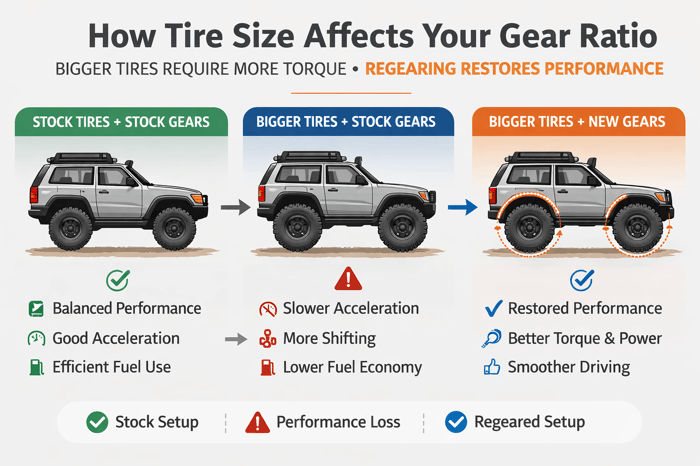
One of the most common upgrades for off-road vehicles is installing larger tires.
Bigger tires provide several advantages:
• Increased ground clearance
• Improved traction
• Better obstacle clearance
However, larger tires also change how your vehicle’s gearing works.
When tire diameter increases, each rotation of the tire covers more distance. This effectively reduces the mechanical advantage created by the axle gears.
Why Tire Size and Gearing Work Together
When modifying a 4WD vehicle, tire size and gearing should always be considered together. Larger tires can improve ground clearance and traction, but they also place additional demand on the drivetrain. If the gearing is too tall for the tire size, the engine may need to work harder than intended, which can affect drivability and efficiency. Matching the correct gear ratio to your tire size helps maintain the vehicle’s performance, allowing it to accelerate smoothly, maintain speed more easily, and deliver power effectively both on the road and on the trail.
Real-World Example: Stock Tires vs. 35-Inch Tires
To understand how tire size affects gearing, it helps to look at a simple example.
Imagine a 4WD vehicle that comes from the factory with 32-inch tires and 3.73 gears. In this configuration, the engine, transmission, and axle gearing are designed to work together to provide balanced acceleration, fuel economy, and drivability.
If the owner upgrades to 35-inch tires, the tires travel farther with each rotation. This effectively reduces the mechanical advantage of the axle gears. As a result, the vehicle may feel slower when accelerating, and the transmission may shift more often to maintain speed.
By switching to 4.56 gears, the drivetrain regains the leverage needed to turn the larger tires efficiently, restoring performance and making the vehicle feel much closer to its original factory behavior.
Signs Your Vehicle May Need Regearing
After installing larger tires, many drivers notice changes in how their vehicle performs.
Common symptoms include:
• Slower acceleration
• Frequent transmission downshifting
• Difficulty maintaining highway speeds on hills
• Reduced towing performance
• Lower fuel economy
This happens because the engine must work harder to turn the larger tires.
Regearing helps restore the balance between engine power and tire size.
Common Gear Ratio Choices for Larger Tires
When upgrading tire size, many off-road enthusiasts choose new axle gear ratios to maintain performance.
While the ideal ratio depends on the vehicle, engine, and transmission, the table below shows some general guidelines. These guidelines are just that - guidelines. Please consult with a 4WD specialist like OK4WD's service department to discuss information specific to your personal vehicle as it will vary.
| Tire Size | Typical Factory Gears | Common Regear |
|---|---|---|
| 33" tires | 3.73–4.10 | Often fine stock |
| 35" tires | 3.73–4.10 | 4.56 |
| 37" tires | 4.10 | 4.88 or 5.13 |
Regearing helps restore the drivability your vehicle had before installing larger tires.
What Is Involved in Regearing?
Regearing means replacing the ring and pinion gears inside your differential with a new gear ratio.
This process requires precise setup to ensure the gears mesh properly.
During a gear install, technicians typically adjust:
• Gear mesh pattern
• Bearing preload
• Backlash tolerances
Because the process requires specialized tools and experience, regearing is usually performed by professional off-road shops or drivetrain specialists. At OK4WD, we have a shop staffed with ASE certified technicians who specialize in 4WD and off road vehicles, making OK4WD a great choice for any regearing needs. To discuss your build and vehicle specifications with on of our specialists, give us a call today or check out our service page for more information.
Final Thoughts
Gear ratios play a major role in how your 4WD vehicle performs both on the road and on the trail.
While factory gearing works well for stock vehicles, modifications like larger tires can change how power is delivered to the wheels.
Understanding how gear ratios work helps you make better decisions about upgrades and ensures your vehicle performs the way you expect when you head off the pavement.
Whether you're building your first trail rig or planning future upgrades, learning the basics of gearing is an important part of getting the most out of your 4WD.
FAQs
What gear ratio is best for off-roading?
Higher numerical gear ratios are generally better for off-roading because they provide more torque to the wheels. Ratios such as 4.56, 4.88, or 5.13 help vehicles climb obstacles, turn larger tires, and maintain control at low speeds.
The best gear ratio depends on factors like tire size, engine power, transmission, and how the vehicle is used.
If you need more help, give OK4WD's service department a call.
Do I need to change my gears when installing larger tires?
Not always, but larger tires often benefit from deeper gears.
When you install bigger tires, the vehicle must work harder to turn them. This can lead to slower acceleration, frequent downshifting, and reduced fuel economy.
Regearing helps restore the performance and drivability your vehicle had with stock tires.
What happens if I don’t regear after installing larger tires?
Many drivers notice several changes after installing larger tires without changing gears, including:
Slower acceleration
Reduced towing power
Difficulty maintaining speed on hills
More frequent transmission shifting
Lower fuel economy
While your vehicle will still function, the overall performance may not feel as responsive.
Is a higher gear ratio better for highway driving?
Lower numerical gear ratios (such as 3.21 or 3.55) are generally better for highway driving because they allow the engine to run at lower RPM.
This improves fuel economy and keeps engine noise lower at cruising speeds.
Higher numerical ratios are typically better for off-road performance and larger tires, but they may cause slightly higher engine RPM on the highway.
How do I know what gear ratio my vehicle has?
There are several ways to find your gear ratio:
Check the axle code on your vehicle’s build sheet
Look for a tag on the differential housing
Use your vehicle’s VIN to check factory specifications
Ask a professional shop to inspect the gears
If you're unsure, give OK4WD's service department a call.
Is regearing a difficult job?
Yes. Regearing involves replacing the ring and pinion gears inside the differential, which requires precise setup and specialized tools.
Improper gear installation can lead to noise, premature wear, or gear failure. Because of this, most vehicle owners have the work performed by experienced drivetrain or off-road specialists.
Give us a call at OK4WD if you need more help on this.
What gear ratio should I run with 35-inch tires?
The best ratio depends on the vehicle, but many off-road enthusiasts running 35-inch tires choose 4.56 gears to restore performance.
Some vehicles with smaller engines or heavier builds may benefit from 4.88 gears.
OK4WD's service department can help determine the best ratio for your specific setup.
Can gear ratios improve towing performance?
Yes. Vehicles used for towing can benefit from deeper gear ratios because they increase the torque delivered to the wheels.
This can make it easier for the vehicle to accelerate, climb hills, and handle heavy loads.
However, the ideal ratio depends on the vehicle and towing requirements.