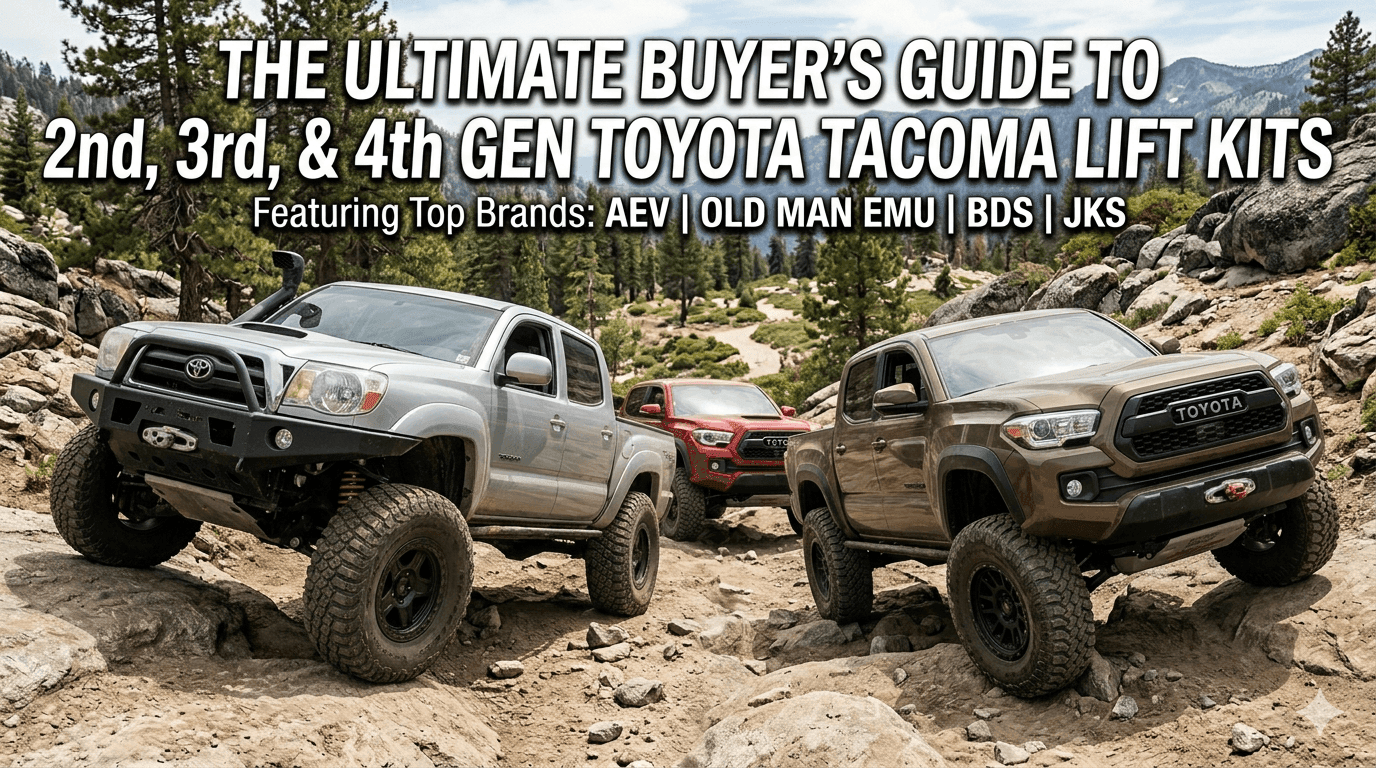
Best Lift Kits for Toyota Tacoma — Buyer's Guide (2nd, 3rd & 4th Gen)
The Toyota Tacoma has one of the most dedicated off-road communities of any truck on the market — and one of the deepest aftermarket ecosystems to match. Whether you're running a well-loved 2nd gen or just picked up a 4th gen, there's a lift kit solution built for your platform. This guide breaks down the best lift kit options by generation, what makes the Tacoma unique to lift, and which brands consistently deliver on this platform.
What Makes the Tacoma Different to Lift?
Unlike solid front axle vehicles like the Jeep Wrangler, all Tacoma generations use independent front suspension (IFS). This makes for a more comfortable daily driver but introduces important engineering constraints when lifting. The core challenge: as you raise the front suspension, CV axle angles increase. Push past the safe operating range and you'll get vibration, premature joint wear, and eventually failure.
This is why upper control arms (UCAs) are one of the most important upgrade considerations on any lifted Tacoma. Quality aftermarket UCAs restore proper CV axle geometry and increase suspension travel — skipping them on anything over 2–2.5 inches of lift is a shortcut that costs you more in the long run.
What to Look for in a Tacoma Lift Kit
Upper control arm compatibility. Confirm whether your lift kit includes UCAs or is designed to work with a specific aftermarket UCA. At higher lift heights this is non-negotiable.
Coilover vs. spacer lift. A coilover conversion replaces your factory strut assembly with an adjustable unit — more expensive upfront but significantly better performance and tunability. Spacer lifts are more affordable but offer limited adjustability and don't improve suspension travel.
Rear lift method. Tacomas use a leaf spring rear suspension. Rear lift options include add-a-leaf kits, replacement leaf packs, or coilover conversions on more aggressive builds. Each has different ride quality and load-carrying implications.
Long-term durability. Tacoma owners tend to keep their trucks — sometimes for 200,000+ miles. Invest in components that will hold up over the long haul rather than needing replacement every few years.
Best Lift Kits by Generation
2nd Gen Tacoma (2005–2015)
The 2nd gen is a proven platform with massive aftermarket support. It's also getting old enough that condition varies significantly — always inspect factory UCAs, ball joints, and leaf springs before building on top of them.
Old Man Emu (OME) by ARB — The OME 2.5" lift for the 2nd gen is one of the most popular and well-regarded setups on the market. It uses OME's nitrocharger sport shocks front and rear with a matched coil and leaf spring upgrade. The result is a balanced, trail-capable ride that doesn't punish you on the highway. For owners who want a reliable, proven setup without overcomplicating the build, OME is the starting point.
BDS Suspension — BDS offers 4" and 6" coilover conversion systems for the 2nd gen that include upper control arms and thorough geometry correction. Their kits are well-documented and designed for owners who want meaningful lift with the hardware to back it up. The included UCAs make this a more complete solution than many competitors at a similar price point.
JKS Manufacturing — While JKS is best known for Jeep platforms, their adjustable geometry components — particularly adjustable upper control arms — are a strong complement to any 2nd gen build where dialed-in suspension geometry is a priority.
3rd Gen Tacoma (2016–2023)
The 3rd gen introduced a revised front suspension geometry and KDSS (Kinetic Dynamic Suspension System) on certain trim levels — a hydraulic sway bar system that disconnects at low speeds for improved articulation. KDSS-equipped trucks require KDSS-compatible lift components, so confirm your trim level before purchasing.
Old Man Emu (OME) by ARB — OME's BP-51 bypass shock system is one of the standout options for the 3rd gen. These are remote reservoir bypass shocks with external adjustment — a significant step up from standard monotube units. For 3rd gen owners who want trail performance without sacrificing daily drivability, the BP-51 setup is hard to beat. ARB also offers KDSS-compatible configurations, which is a meaningful differentiator.
AEV (American Expedition Vehicles) — AEV's Tacoma suspension systems bring the same philosophy they apply to Jeep builds — engineered specifically for the platform with no compromises. Their 3rd gen kits focus on maintaining proper geometry while improving capability, and they integrate cleanly with other AEV components if you're building toward a more complete overland rig.
BDS Suspension — BDS's 3rd gen coilover systems are a strong mid-range option, particularly for owners targeting the 3–4" lift range with 33s or 35s. Their kits include Fox shocks on upper configurations and are available in KDSS and non-KDSS fitments.
4th Gen Tacoma (2024+)
The 4th gen Tacoma is the newest platform and the aftermarket is still catching up — but it's catching up fast. The 4th gen introduces a new frame, revised suspension geometry, and the TRD Pro's factory-fitted Fox internal bypass shocks, which set a higher baseline than previous generations.
Old Man Emu (OME) by ARB — ARB has been among the first to develop 4th gen-specific components, consistent with their pattern of prioritizing new Toyota platforms. Availability is expanding — check current fitment with your installer as the catalog continues to grow.
BDS Suspension — BDS has been active in developing 4th gen fitments and is worth checking for coilover and leveling solutions as their catalog expands.
At this stage of the 4th gen's life, working with a specialty installer who stays current on new fitments is especially important. The platform is capable and the aftermarket interest is high — the options will continue to grow significantly over the next 12–24 months.
How Much Lift Do You Actually Need?
| Goal | Recommended Lift |
|---|---|
| Cleaner stance, mild tire upgrade | 1.5"–2.5" |
| Run 33s comfortably | 2.5"–3" |
| Run 35s — sweet spot for most builds | 3.5"–4" with UCAs |
| Run 37s and beyond | 4.5"+ full build with geometry correction |
A Note on Upper Control Arms
It bears repeating: if you're lifting a Tacoma more than 2–2.5 inches, aftermarket upper control arms are not optional — they're essential. Factory UCAs are designed around factory ride height. Lift the truck without correcting the UCA geometry and you're loading the CV axles at angles they weren't built to sustain. Quality UCAs from ARB, BDS, or platform-specific manufacturers restore proper geometry, increase caster correction, and in most cases add suspension travel compared to the factory setup.
Bottom Line
The Tacoma is one of the most rewarding trucks to build — a deep aftermarket, a passionate community, and a platform that responds well to quality components. For 2nd gen owners, OME and BDS are proven starting points. For 3rd gen builds, ARB's BP-51 system and AEV's platform-specific engineering stand out. For 4th gen owners, the aftermarket is moving fast and working with a knowledgeable installer matters more than ever.
At OK4WD we stay current on fitments across all three generations — including the 4th gen as the catalog develops. Stop into our Stewartsville location or give us a call and we'll put together the right build for your truck, your budget, and the trails you're running.
OK4WD has been building trucks and Jeeps since 1979. Browse our Tacoma lift kit inventory or schedule a consultation with our service team.
FAQs
Do I need upper control arms with a Tacoma lift kit?
At 2–2.5 inches and under, many owners run without them. Above that, UCAs are strongly recommended to maintain proper CV axle angles and prevent premature wear and vibration.
Does lifting a Tacoma affect towing capacity?
A properly installed lift with correct geometry correction has minimal impact on towing capacity for typical use. Aggressive lifts with significant geometry changes can affect towing stability — consult your installer if towing is a regular use case.
Is my 3rd gen Tacoma KDSS equipped?
KDSS is available on TRD Off-Road and TRD Pro trims on the 3rd gen. Check your build sheet or look for the hydraulic lines running along the front and rear sway bars. If you're unsure, your installer can confirm before purchasing a kit.
How long does a Tacoma lift install take?
A 2.5" coilover lift typically runs 4–5 hours. A full 4" coilover conversion with UCA swap and tire fitment can take a full day or more depending on the shop and configuration.