Best 4×4 Trails & Overland Routes in the Rocky Mountains
If the Southwest is about scale and scenery, the Rocky Mountains are about elevation and challenge.
This is where trails climb above tree lines, weather changes by the hour, and your vehicle—and planning—get tested in a different way.
At OK4WD, this is the region people start looking at when they want to take the next step beyond casual off-roading. It’s not just about getting out—it’s about being prepared for real terrain and real conditions.
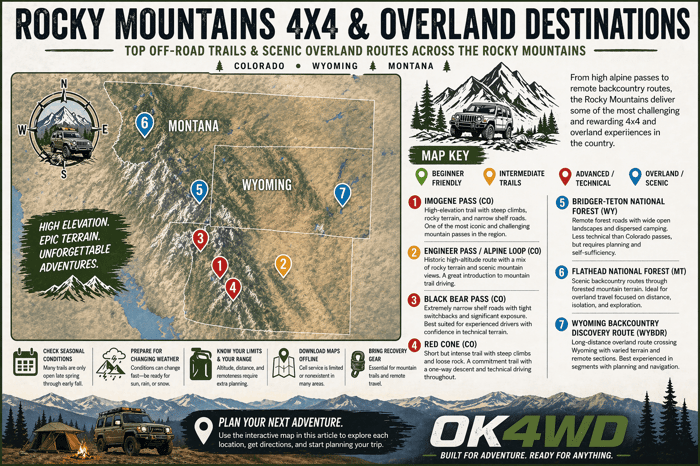
Use the interactive map below to explore each destination by difficulty and terrain.
Best 4×4 Trails & Overland Routes in the Rocky Mountains | OK4WD
What We Mean by “Rocky Mountains”
For this guide, we’re focusing on:
- Colorado
- Wyoming
- Montana
Most of these trails are seasonal, typically open from late spring through early fall depending on snowpack.
What to Know Before You Go
The Rockies are different from every other region:
- Altitude matters — both for vehicles and drivers
- Weather changes fast — storms can roll in quickly
- Short season — many passes are snow-covered most of the year
- Exposure is real — steep drop-offs and narrow shelf roads
This isn’t a region where you wing it. Planning ahead makes a big difference.
1. Imogene Pass, CO
Best for: Advanced | Terrain: High elevation, rocky, steep climbs
One of the most iconic high-altitude trails in the country.
What to expect:
- Elevation over 13,000 feet
- Tight shelf roads
- Rocky climbs and descents
Local insight:
The views are incredible—but so is the exposure. Weather can change quickly at this elevation, so timing matters.
2. Engineer Pass / Alpine Loop, CO
Best for: Intermediate | Terrain: Rocky, scenic mountain routes
Part of the famous Alpine Loop, this is one of the best all-around experiences in the Rockies.
What to expect:
- Mix of terrain
- Historic mining roads
- Scenic mountain passes
Local insight:
This is a great introduction to high-altitude driving without jumping straight into the most technical trails.
3. Black Bear Pass, CO
Best for: Advanced | Terrain: Narrow shelf roads, steep descents
Not for the faint of heart.
What to expect:
- Extremely narrow sections
- Tight switchbacks
- Significant exposure
Local insight:
This trail is as much about driver confidence as vehicle capability. Know your limits before attempting it.
4. Red Cone, CO
Best for: Advanced | Terrain: Loose rock, steep climbs
A short but intense trail that’s well known in the Colorado off-road community.
What to expect:
- Steep ascents
- Loose terrain
- Technical descent
Local insight:
This is a “commitment” trail—once you’re in, you’re finishing it.
5. Bridger-Teton National Forest, WY
Best for: Overlanding | Terrain: Forest roads, remote routes
If you’re looking for space and solitude, this is it.
What to expect:
- Long forest roads
- Remote camping opportunities
- Minimal traffic compared to Colorado
Local insight:
Less technical than Colorado passes, but more remote. Planning and self-sufficiency matter.
6. Flathead National Forest, MT
Best for: Overlanding | Terrain: Forest roads, mountain terrain
Montana brings a different feel—less crowded, more open.
What to expect:
- Scenic backcountry routes
- Remote travel
- Wildlife and isolation
Local insight:
This is where overlanding starts to feel more like true backcountry travel.
7. Wyoming BDR (WYBDR)
Best for: Overlanding | Terrain: Mixed terrain, long-distance route
A long-distance route that crosses the state with a mix of terrain and conditions.
What to expect:
- Multi-section route
- Dirt roads, gravel, and remote terrain
- Big mileage potential
Local insight:
Like other BDR routes, you don’t need to run the entire thing. Breaking it into sections makes it manageable.
Essential Gear for a Rocky Mountains Trip
This region exposes both vehicle and planning gaps quickly:
- Recovery gear (traction boards, straps, winch)
- Air system (adjusting for terrain changes)
- Navigation tools (offline maps required)
- Warm clothing (even in summer)
- Extra fuel and water
Altitude and weather make preparation critical.
Tips for Planning a Successful Trip
- Check trail conditions and seasonal openings
- Start early to avoid afternoon storms
- Be prepared for rapid weather changes
- Don’t underestimate altitude effects
- Know your vehicle’s limits
Final Thoughts
The Rockies aren’t about casual trail rides—they’re about earning the experience.
Between elevation, terrain, and weather, this region demands more—but it also delivers some of the most rewarding driving in the country.
FAQs
When are these trails open?
Most are open from late spring to early fall, depending on snow.
Is this region beginner-friendly?
Some trails are, but many require experience and proper setup.
Do I need permits?
Some areas may require passes or have restrictions—always check ahead.