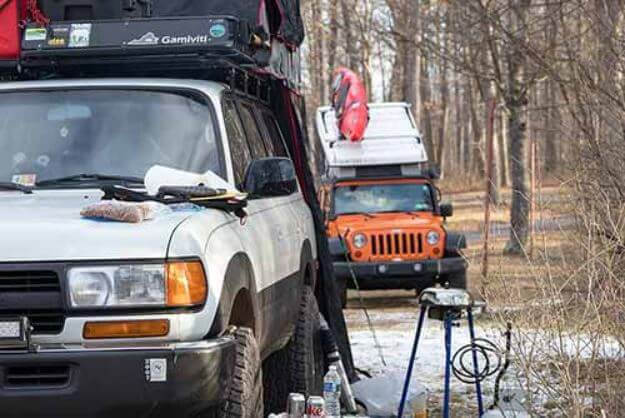
It was all over the news. The mid-atlantic states were about to be slammed by a nor’easter, named Stella, which threatened to dump a large amount of snow, and likely close roads all over the region. I was in New Jersey on business when I heard the warnings. Intent upon avoiding the snow, I immediately set off for Thomas, West Virginia, which had been my planned destination for its vibrant arts culture, food, coffee, and its close proximity to wilderness.
Parking Precariously

Arriving at midnight, the town was fast asleep. I discreetly parked the Jeep along a public road, only a short walk from the town’s popular storefronts and venues. Still new to my vehicle-based lifestyle, I had concerns about my chosen parking location. Is it safe? Is it legal? Will it draw unwanted attention?
While the footprint of the Jeep with the camper deployed is the same as that of any parked vehicle, raising the roof is akin to waving a flag that screams, “Look at me!” and stealth-camping, with the camper lowered, is not a desirable option.
Nevertheless, I opened the camper, and for the duration of my stay, I wasn’t bothered by anyone. I’ve found that Thomas is a very friendly and inviting town, welcoming to tourists, passersby, and accommodating to those pursuing a nomadic lifestyle.
Weathering the Storm


Throughout the week, the temperature was usually in the teens during the night, with the exception of one morning that was in the single-digits. A very old, 0 degree, mummy bag kept me warm, in addition to a long-sleeve shirt, a sweatshirt, a hooded winter coat, a face mask, fleece pants, and two pairs of wool socks. In fact, I was quite comfortable as long as I remained inside the sleeping bag.
Every day, it snowed; usually gently, but sometimes it was accompanied by gusts of wind. Precipitation was on an off, and accumulation was gradual, but steady. The Ursa Minor camper gracefully endured the snow, kept me dry, and mostly warm.
I remained bundled up for the duration of my stay, sought refuge in the nearby coffee shop, and tried not to let the weather conditions diminish my sense of adventure!
Getting to know Thomas


Thomas, West Virginia, rich with history, was once a bustling coal town. Mining operations ceased in the early 20th century, and ever since, it has been a secluded dot on the map, adjacent to the Monongahela National Forest.
Today, with a population of less than 750, rural Thomas has become a cultural hot-spot for arts and music in West Virginia. Many of the 19th century buildings are in the process of being restored, and Front Street is lined with shops and cafes doubling as music venues. Notably, TipTop is an inviting cafe that offers coffee, edibles, and a full bar with craft beer. Also nearby, The Purple Fiddle offers health-conscious wraps, sandwiches, craft beer, and some of the best live music from traditional artists that you’ll ever experience.
I spent the majority of the week in TipTop, taking advantage of their public Internet access, and doing web development work on my laptop.
One evening, I indulged, and walked over to The Purple Fiddle to enjoy a wrap, and experience some live music. A violinist named Zach Brock was playing, and he was extraordinary. He played a mix of folk, classical, contemporary, was accompanied briefly by local musician Heather Hannah Nelson, and it was truly a memorable performance.
The Olson Observation Tower


At the end of the week, I left the Thomas city limits and set off into the nearby Monongahela National Forest for a quiet weekend in the West Virginia wilderness.
Not far from Thomas, down a primitive forest road, is a decommissioned, historical fire tower named the Olson Observation Tower that offers a stunning 360 degree view of the surrounding mountains. The tower is publicly accessible, and is a 133 step climb to the top! It’s worth a visit, but if you seek it out, please be safe, be respectful, and leave this treasure as you found it.
The Canaan Loop


Only a short drive south, adjacent to Blackwater Falls State Park, there is a primitive road called The Canaan Loop. This is a 14 mile horseshoe that has a number of interesting features. On the southern end it’s a well-groomed gravel road, but on the northern end, it’s a rugged, four-wheel drive two-track with some rocky terrain and stream crossings. The scenery is gorgeous, and the route is lined with hiking trails, campsites, and fly-fishing access.
On this occasion, I chose not to traverse the entire route, as I was alone, and the road was completely snow-covered. Even the well-groomed section was treacherous, so I didn’t need to push my luck through the technical section.
I found an inviting spot to pull-off in the valley, along a section of road that wound its way through rhododendron. There, I deployed camp and settled in for the remainder of the weekend, not encountering another soul for the entire duration,
On Sunday, while the snow on the ground remained, the sky cleared up, and I seized the opportunity to set off on foot and explore some hiking trails within walking distance from the Jeep. I donned my waterproof boots, layered up, grabbed my camera sans memory card, and trekked roughly 6 miles in fresh, ankle-deep snow.
It was an amazingly peaceful hike in the snow, following the Lindy Run trail, the Plantation Trail, and the Railroad Grade trail, which looped back to the Jeep. However, by the time I was done, I was ready for some downtime and a hot chocolate!