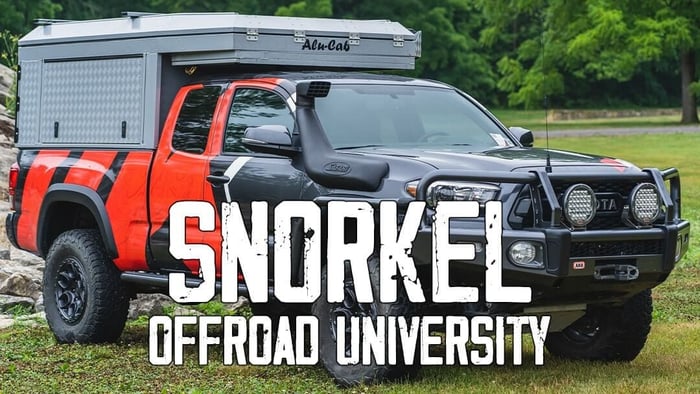
Snorkels
Maintaining constant fresh, clean air to a vehicles intake is essential to keeping the adventure moving down the trail.
In this Article we will cover:
What is a Snorkel
A snorkel is an exterior addition to your vehicles intake that relocates where air enters your vehicles intake to help prevent dust, water and other microparticles from entering your engine. The job of a air intake is in the name. An engine requires clean, cold air to maximize engine combustion.
A factory air intake is located in one of two places. Traditionally located behind the headlight or the back corners of the engine compartment. Fresh air makes its' way through the air intake via the wheel well or front grill of the vehicle. The intake pulls cold air through a filter into the engines intake manifold and is used during the engine combustion process.

A factory intake location works very well for the daily commuter when time spent traveling is on the road. But if you are looking to spend time off the beaten path a snorkel could be a worth while investment.
Benefits
A snorkel's job is to provide fresh air to the engine under all weather and driving conditions. A snorkels function doesn't stop at only traveling through water in fact, a vehicle can benefit from a snorkel in every driving condition. With a 10% higher CFM rating over a factory air intake a snorkel allows more air to enter the engine.

Water Crossings
Travel through water with your vehicle can be dangerous. Especially if the water level reaches near the top of the hood. If water levels reach the headlights, there is a good chance the water has reached the factory air intake location.

If water reaches the air intake, the water can get sucked through the air filter and the trouble can begin. Once past the filter, water then fills the engines cylinders causing hydrostatic lock or hydrolock for short.
Hydrolocking a motor means a piston has filled with fluid. Engines compress an air/fuel vapor mixture in the cylinder until it combusts. Fluid simply doesn’t compress like a gas does. When the piston reaches the fluid it cannot be compressed forcing the piston to stop. When one piston stops, they all do, stopping the engine until the water is removed.

Relocating the air intake to the top of the vehicle, with a snorkel, provides fresh air to enter the intake housing nearly three feet higher than its factory location. The new location will keep water from entering the intake but, after crossing water it is always good practice to stop and check the filter for any moister. Air filters are still under the hood in an air-tight box but any experienced traveler will say the same, "Check your filter after water crossings"
Dust
Off-road travel means dirt and dusty roads. When traveling off the beaten path it is rare to travel alone, which means a lot of dust. Dust will clog a filter, reducing the amount of air entering the engine causing a loss of power.
The factory air filter location of the wheel well or front of the vehicle will suck in large amounts of dust. The wheel well while on the road makes for a great location for fresh air, but not when off-road and the tires are producing dust. The same goes for the front of the vehicle. Wile traveling behind another vehicle, the intake will collect all that dust filled air.

With a snorkel the air inlet can be adjusted to match driving conditions. While traveling on paved roads the air inlet of the snorkel should face forward. Allowing fresh air to enter the snorkel. On dirt roads rotating the air inlet to face the rear of the vehicle allows fresh air to be pulled in keeping dust filled air out of the snorkel.
Snow & Rain
During rain and snow storms the mist produced from travelers tires enters factory air intake openings. As stated above after the entering the air intake opening the only barrier to the motor is the air filter. Although the amount of water can be minimal, in some cases, water can soak the air filter.
Aftermarket snorkels have taken this into consideration. Snorkels have an air ram design that acts as a highly efficient water separator to remove rain water from entering the air filter letting your vehicle breath clean cold air.

Installation
Installing the snorkel does require cutting a whole through a fender to reach the factory air box. This process, although invasive, can be done easily with an included template.

After placing the template a pilot whole must be drilled followed a large whole saw bit. After cutting the whole and removing any burrs paint the raw edge to prevent any rusting. The snorkel then attaches to the factory air box with an air tight seal.
We want to hear from you!
Let our pros find the correct snorkel for your vehicle. Installation have you concerned? Our trained mechanics are no strangers when it comes to snorkel installations. Contact us today or stop by to schedule an appointment.